

Zero Trust methodology is a cybersecurity paradigm that shifts defenses from static, network-based perimeters to focus on users, assets, and resources. It operates on the principle of "never trust, always verify", meaning no implicit trust is granted based solely on network location or asset ownership.
Instead, every access request is explicitly authenticated and authorized using multiple attributes and dynamic cybersecurity policies.
As such, key aspects of Zero Trust include:
- Assuming a hostile environment and presuming breach: By operating with the understanding that adversaries are both inside and outside the network, and that a breach is always a possibility.
- Protecting resources, not network segments: The focus is on safeguarding data, applications, assets, and services, as the network location is no longer considered the primary component of security.
- Continuous verification: Authentication and authorization are discrete functions performed continuously throughout user transactions.
- Least privilege access: Access to resources is granted on a per-session basis with the minimum privileges needed to perform the mission.
Both the NIST Special Publication 800-207, "Zero Trust Architecture", and the Department of Defense Zero Trust Reference Architecture (DoD ZT RA) emphasize these principles. The DoD ZT RA specifically leverages concepts and lexicon from NIST guidance to provide a unified approach to implementing Zero Trust architecture.
Zero Trust as an architecture
Think of the architecture as the actual blueprint or framework that brings the "never trust, always verify" philosophy. It's how organizations design and implement their security infrastructure to enforce those Zero Trust principles discussed above.
A key part of this architecture is how it handles access.
Instead of just checking who you are once at the door, Zero Trust architecture requires dynamic runtime access control. This means that every time you try to access a resource, such as a file or an application, the system is constantly evaluating whether you still have the right to access it. It's not a one-and-done check.
For example, if your role changes, the risk level of your device goes up, or even if the data you're trying to access becomes more sensitive, the architecture can dynamically check your access privileges in real-time.
This continuous monitoring and re-evaluation are crucial for keeping things secure in a world where threats are always evolving. It's all about making sure that access is granted only for what's absolutely necessary, and for as long as it's needed, aligning perfectly with the principles laid out in documents like NIST 800-207 and the DoD ZT Architecture.
What role does a policy engine play in a Zero Trust architecture?
For this answer, we can look to NIST 800-207 as a guide.
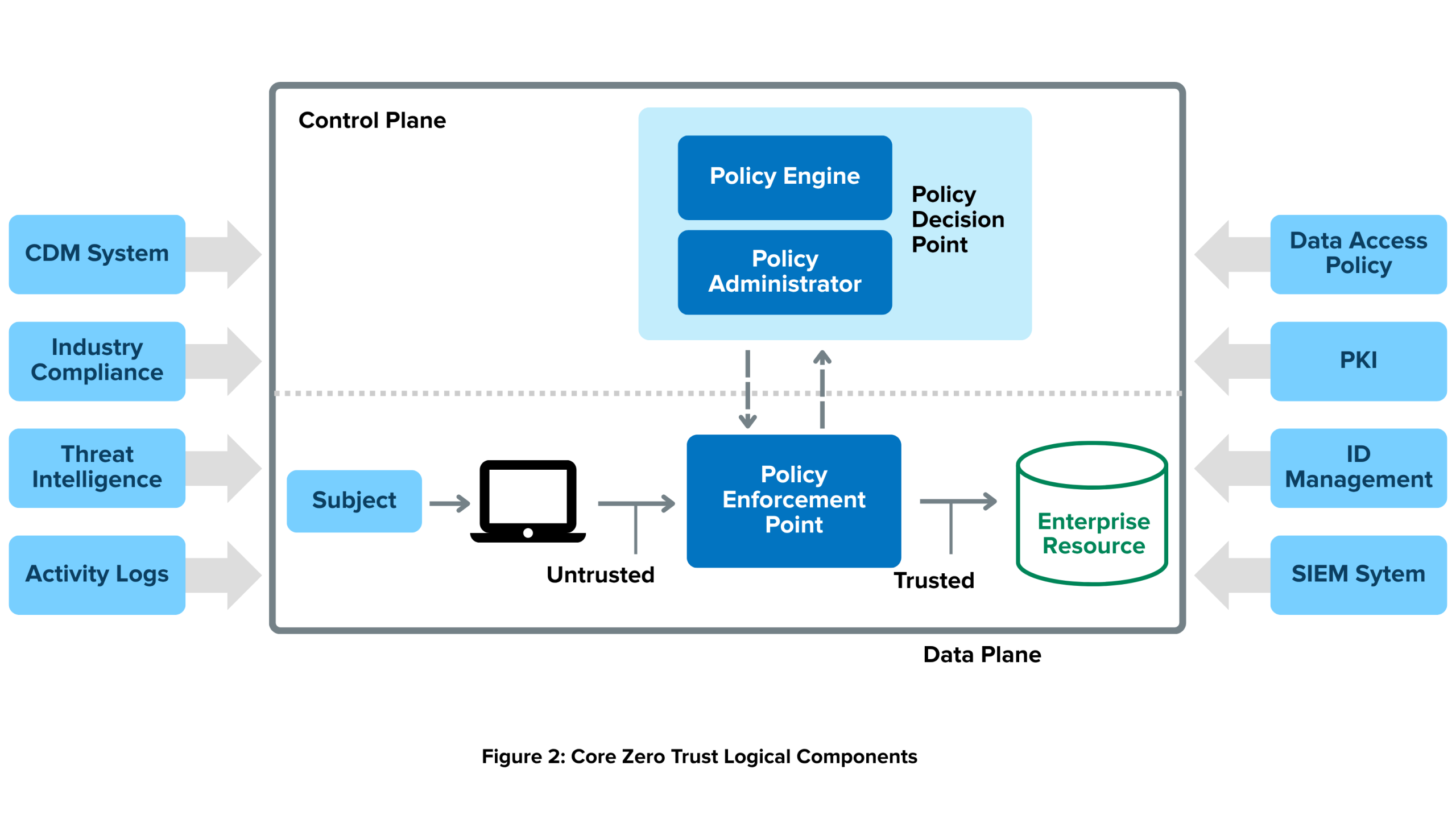
One of the key components of the Zero Trust logical components is the Policy Engine itself. Policy-based, it helps determine whether access should be granted or denied.
This component is responsible for the ultimate decision to grant access to a resource for a given subject. The Policy Engine uses enterprise policy as well as input from external sources (e.g., CDM systems, threat intelligence services described below) as input to a trust algorithm (see Section 3.3 for more details) to grant, deny, or revoke access to the resource. The PE is paired with the policy administrator component. The Policy Engine makes and logs the decision (as approved, or denied), and the policy administrator executes the decision." Source: nvlpubs.nist.gov
Why a Policy Engine is key to Zero Trust
The Policy Engine is critical in Zero Trust because it is the central decision-making component that enforces the "never trust, always verify" principle. It evaluates every access request against defined enterprise policies and various external inputs to determine whether a user or system should be granted access to a specific resource.
A Policy Engine is important because it:
- Enforces dynamic access control: Unlike traditional perimeter-based security, a Zero Trust Policy Engine provides dynamic, real-time access control. It doesn't just check credentials once; it continuously assesses context (user identity, device health, resource sensitivity, threat intelligence, etc.) throughout a session to ensure ongoing authorization.
- Centralizes decision making: It acts as the brain of the Zero Trust architecture, centralizing all access decisions. This ensures consistent policy enforcement across the entire enterprise, regardless of where users or resources are located.
- Enables least privilege access: By evaluating requests on a per-session, per-resource basis, the Policy Engine ensures that users are only granted the minimum necessary privileges to perform their tasks, for the shortest possible duration. This significantly reduces the attack surface.
- Adapts to evolving threats: Through its ability to integrate with various external data sources (e.g., threat intelligence, security information and event management (SIEM) systems, continuous diagnostics and mitigation (CDM) systems), the Policy Engine can dynamically adjust access decisions based on real-time risk assessments. If a device becomes compromised or a new threat emerges, the Policy Engine can immediately revoke or restrict access.
- Provides auditability and visibility: All access decisions made by the Policy Engine are logged, providing a clear audit trail. This is crucial for compliance, incident response, and understanding access patterns within the organization.
In essence, the Policy Engine translates the theoretical principles of Zero Trust into actionable, enforceable security decisions, making it indispensable for a robust and adaptive Zero Trust implementation.
Axiomatics as a Zero Trust Policy Engine
In a stroke of luck, or perhaps security common sense, the NIST 800-207 architecture aligns with the NIST ABAC 800-162 architecture. Axiomatics has been spearheading and following the attribute-based access control (ABAC) architecture since its inception.
We implement the password authentication protocol (PAP), the policy enforcement point (PEP), the policy decision point (PDP), and the policy information point (PIP) parts of the ZT architecture. Our policy engine has been designed to be stateless and side effect-free, meaning it can scale vertically and horizontally.
Take the next step towards Zero Trust
Axiomatics’ attention to detail, scale, performance, and standards positions our policy engine as a leader in the policy-based access management market.
As previously mentioned, your organization can achieve the use cases required at scale.
Additionally, because our solution is based on Abbreviated Language for Authorization (ALFA), it is easy for developers and product owners to implement and test their use cases. It further simplifies audit and access reviews, making them easily accessible through a user-friendly interface. Other languages like Open Policy Agent’s Rego are extremely powerful, but are also extremely complex to learn and deploy.
Using Axiomatics, customers can quickly and easily achieve:
- Developer efficiency: Developers can write their authorization requirements as policy rather than in brittle, hard-to-maintain code. The policies can be reused across any number of applications.
- Consistency & continuous authorization: With a central location to define authorization, we can eliminate silos and close security gaps by ensuring the same policies are in place across a broad range of applications, APIs, and data sources.
- IAM streamlining: Eliminate role explosion and reduce the need for repetitive user access recertifications.
- Compliance & security: Demonstrate continuous compliance with evolving regulations and strengthen overall security posture.
Connect with one of our experts to learn why Zero Trust fits your organization’s needs. Check out our Zero Trust solution page and schedule a demo for a deeper dive with our experts.