1. Home
  2. |
  3. Axiomatics Authorization Management Platform
  4. |
  5. Trusted Standards for Enterprise Authorization

Trusted Standards for Enterprise Authorization

From XACML and ALFA to AuthZEN, Axiomatics has helped shape the standards behind modern authorization.

Innovation

A Commitment to Standards

For twenty years, standards have been central to our approach to authorization. From helping shape key standards like XACML, ALFA, and OpenID AuthZEN, we see standards as more than a checkbox. They are a critical foundation for trust and innovation.

  • Modernize authorization without vendor lock-in
  • Maintain consistent access controls across environments
  • Accelerate cloud, API, and AI initiatives

Why does Authorization Need Standards?

Enable Interoperability

Ensure authorization policies and decisions work consistently across applications, clouds, APIs, partners, and vendors.

Reduce Development Overhead

Leverage standardized frameworks and protocols to minimize custom code, simplify integrations, and accelerate application delivery.

Strength Security and Governance

Apply consistent access controls and policy enforcement across environments to improve security, compliance, and auditability.

Accelerate Innovation

Build and deploy authorization capabilities faster using proven standards that simplify integration and adoption.

AuthZEN Working Group

A New Standard for Interoperable Authorization

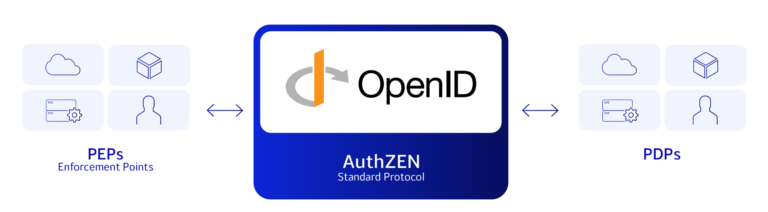
AuthZEN is a new standard from OpenID Foundation that enables interoperable authorization across applications, APIs, and services. It standardizes how a policy enforcement point (PEP), such as an app or API gateway, communicates with a policy decision point (PDP), the external engine that evaluates policies and makes real-time authorization decisions.

Axiomatics is a proud founding member of the OpenID AuthZEN Working Group. We help bring this standard to life for enterprises. Our CTO serves as one of the co-chairs of the group and we actively represent AuthZEN at industry events.

How AuthZEN Works

AuthZEN defines a standard, vendor-neutral request/response interface between PEPs and PDPs, enabling interoperable authorization across vendors and platforms.


Authorization Policy Languages

The Standard Languages Behind Authorization

XACML and ALFA established a common approach for defining, managing, and evaluating authorization policies.

eXtensible Access Control Markup Language (XACML) is an OASIS standard that provides a common framework for defining and evaluating authorization policies independently from applications. By separating policy from application logic, organizations can manage authorization more consistently, securely, and at scale.

This approach laid the foundation for modern authorization architectures by enabling organizations to:

  • Centralize authorization policies
  • Enforce consistent governance across systems
  • Move beyond static role-based access control
  • Enable fine-grained access controls

Abbreviated Language for Authorization (ALFA) is a human-readable policy language designed to simplify the creation and management of authorization policies. Donated to OASIS and based on Axiomatics designs, ALFA helps developers and policy authors write clear access control policies. It avoids XML complexity, making authorization easier to build, understand, and maintain.

  • Write human-readable, easy-to-maintain authorization policies
  • Express fine-grained access rules without complex policy syntax
  • Reuse policy structures and attributes across applications

FAQs

AuthZEN is an authorization standard from the OpenID Foundation that defines a common, vendor-neutral way for Policy Enforcement Points (PEPs) to request authorization decisions from Policy Decision Points (PDPs). It enables interoperable, real-time, policy-based access control across applications, APIs, and services, supporting consistent authorization in distributed and cloud-native environments.

Abbreviated Language for Authorization (ALFA) is a high-level, human-readable language for defining access control policies. It simplifies the creation and management of authorization rules by offering a more concise and intuitive syntax, compiling it into XACML, and helping you write, read, and maintain complex policy logic more easily.

eXtensible Access Control Markup Language (XACML) is an OASIS standard for attribute-based access control (ABAC). It provides a policy language and evaluation framework for defining fine-grained authorization rules based on attributes such as user, resource, action, and environment, enabling dynamic and context-aware access decisions across systems.

A policy enforcement point (PEP) enforces access in places such as an application, API, or gateway. A policy decision point (PDP) evaluates authorization policies and decides whether to allow or deny access.

Standards reduce fragmentation by ensuring different systems can communicate in a consistent way. This improves interoperability, reduces custom integration work, strengthens security consistency, and helps organizations scale authorization across complex environments.

At their best, standards:

  • Enable interoperability across vendors and platforms
  • Reduce complexity for developers and enterprises
  • Improve security, governance, and compliance

Request a Demo

Take the Next Step in Securing Your Enterprise Systems

Schedule a meeting with our experts to discover how the Axiomatics Authorization Management Platform helps you implement fine-grained access control, support Zero Trust, and meet today's security and compliance requirements.

Explore More Content

From AI to Authorization: Key Takeaways from Identiverse 2026

7 min read

This website uses cookies

Cookies consist of small text files. They contain data that is stored on your device. To enable us to place certain types of cookies we need to obtain your consent. At , corp. ID no. , we use the following kinds of cookies. To read more about which cookies we use and storage times, click here to access our cookies policy.

Manage your cookie-settings

Necessary cookies

Check to consent to the use of Necessary cookies
Necessary cookies are cookies that must be placed for basic functions to work on the website. Basic functions are, for example, cookies which are needed so that you can use menus on the website and navigate on the site.

Functional cookies

Check to consent to the use of Functional cookies
Functional cookies need to be placed on the website in order for it to perform as you would expect. For example, so that it recognizes which language you prefer, whether or not you are logged in, to keep the website secure, remember login details or to be able to sort products on the website according to your preferences.

Cookies for statistics

Check to consent to the use of Cookies for statistics
For us to measure your interactions with the website, we place cookies in order to keep statistics. These cookies anonymize personal data.

Personalization cookies

Check to consent to the use of Personalization cookies
In order to provide a better experiance we place cookies for your preferances

Cookies for ad-tracking

Check to consent to the use of Cookies for ad-tracking
To enable us to offer better service and experience, we place cookies so that we can provide relevant advertising. Another aim of this processing is to enable us to promote products or services, provide customized offers or provide recommendations based on what you have purchased in the past.

Ad measurement user cookies

Check to consent to the use of Ad measurement user cookies
In order to show relevant ads we place cookies to tailor ads for you

Personalized ads cookies

Check to consent to the use of Personalized ads cookies
To show relevant and personal ads we place cookies to provide unique offers that are tailored to your user data