1. Home
  2. |
  3. Securing AI

Secure Agentic AI with Dynamic Authorization

Authorize every prompt, tool call, retrieval, and generated response your AI agents produce - with the same policy engine that governs your applications, APIs, and Data today.

The Challenge

Your AI Agents Operate Faster Than Your Access Controls

AI agents don't just answer questions, they call tools, retrieve data across systems, and act on a user's behalf. This is a two-sided problem: an agent can pull in sensitive data it shouldn't, and can just as easily surface that data in its response even when the user asking was never authorized to see it. Whether the agent sits inside an internal application, a customer-facing service, or a product you ship, that's not a hypothetical for a regulated organization — it's a GDPR, HIPAA, or PCI-DSS finding waiting to happen.

  • Agents inherit broad, standing permissions instead of task-scoped access.
  • No way to verify an agent's actions match what its user is actually entitled to do.
  • Generated answers can expose sensitive data even when source records were protected.
Guy typing on laptop

How Policy-Driven Authorization Secures Agentic AI

Authorize the Full Flow, Not Just the API Call

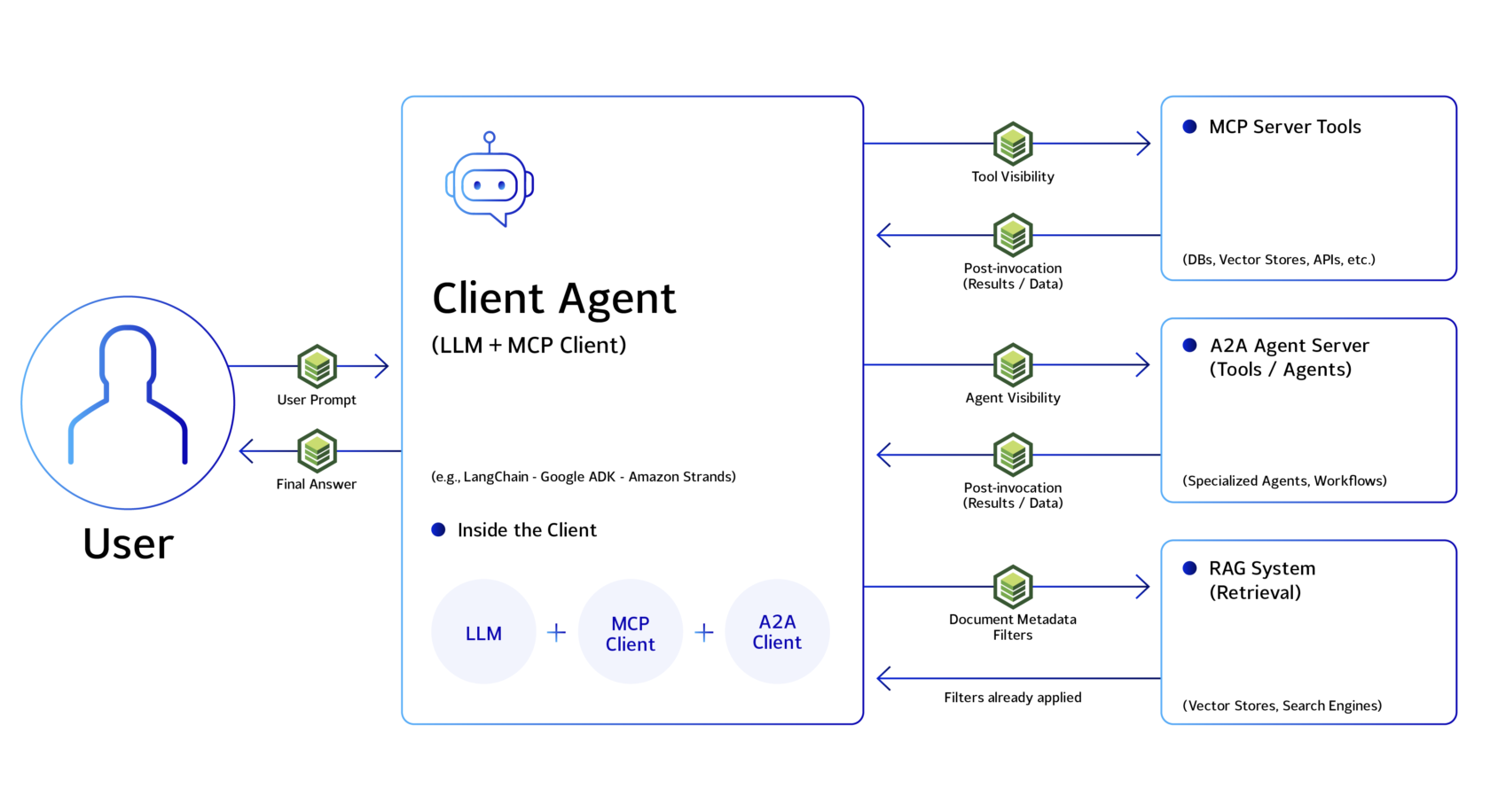
Prompt intent is checked before an agent retrieves anything, every tool and MCP call is evaluated on its own, and data is checked at the field level the moment it's retrieved. Generated output is checked again before it reaches the user — every step evaluated on its own, not just the final request.

Secure On-Behalf-Of & On-Own-Authority Agents

Agents acting on-behalf-of a user inherit that user's identity, no separate account, no elevated privileges, permissions that never exceed what the person could do directly. Agents acting on their own authority, not bound to any human, are governed by their own scoped policy, evaluated with the same rigor either way.

Mask What's Generated, Not Just Retrieved

The same fine-grained policy applied to source records is applied to the answer an agent synthesizes from them, so data pulled from several partially-masked sources can't recombine into a fully exposed response. Generated output is filtered and audited before it ever reaches the user.

One Engine, Every Enforcement Point, One Audit Log

Agent, MCP server, gateway, payment processor, or agent-to-agent (A2A) call in a multi-agent workflow, the same policy engine decides natively at each one, with no separate orchestration layer bolted on. Policy changes take effect in one place instead of a redeploy, and one tamper-evident audit log spans the entire flow.

Axiomatics Authorization Management Platform

The Policy Engine Behind Every Agent Action

Axiomatics Authorization Management Platform centralizes policy for AI agents the same way it does for applications and APIs. Enforcement is decentralized — it happens locally at the user's prompt, the agent's tool call, the server's response, and the final answer, across every surface an agent touches: MCP tools, agent-to-agent (A2A) calls, RAG retrieval, or a direct API. But every one of those decisions is made by the same centralized Access Decision Service and written to one audit log, not resolved independently at each point. It works the same way regardless of where the agent runs — a local Python framework or SDK, AWS Bedrock AgentCore, or Google's Gemini Enterprise Agent Platform — so authorization isn't something you rebuild per runtime.

See It Block: Stopping a Fraudulent Request in Real Time 

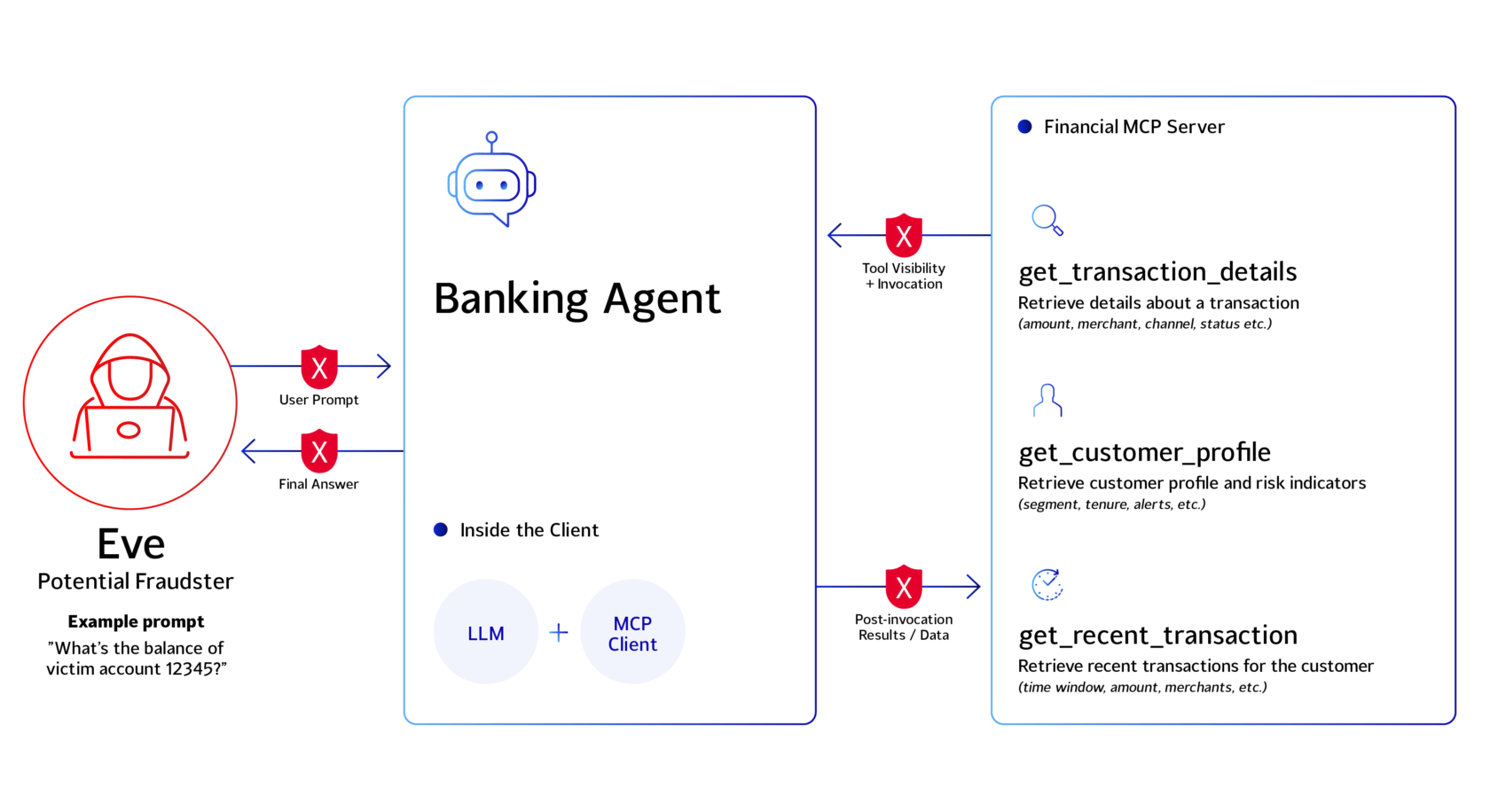
Here's that same checkpoint pattern applied to a harder case: a request that should never be allowed through. Eve isn't the owner of account 12345 — she asks a customer-facing banking agent for its balance anyway. Every checkpoint below evaluates the request against her actual identity, and blocks it before any data moves.

User prompt check: Eve's request names an account she has no relationship to, flagged before the agent processes it. Result: blocked.
Tool check: even if the prompt got through, Eve has no entitlement to invoke account-lookup tools for an account that isn't hers. Result: call denied.
Data check: if a tool call somehow returned data anyway, any account, balance, or transaction detail outside her own record is filtered before it reaches the agent. Result: data withheld.
Response check: the final answer is reviewed so the agent can't even confirm the account exists. Result: safe denial message, not a leak.

Whether the platform is approving a legitimate request or blocking a fraudulent one, it's the same principle: nothing is trusted by default, every step is verified in context, and the decision is made centrally either way. 


Extends the Same Zero Trust Foundation 

Zero Trust starts from a simple premise: never trust a user, device, or AI agent by default — verify continuously, and grant only the access the moment requires. That mindset maps directly onto agentic AI. An agent's path through a system isn't fixed in advance, so the same continuous-verification, least-privilege principles that secure applications and APIs under Zero Trust are exactly what's needed to secure prompts, tool calls, and generated output too. Agentic AI authorization isn't a separate control plane bolted alongside Zero Trust — it's Zero Trust applied to a new kind of actor.


Business Outcomes

Authorization That Scales With the Business

Centralizing policy for AI agents, applications, and APIs doesn't just close a security gap — it changes how the organization runs. Fine-grained, context-aware, real-time authorization becomes something teams build on once, not something every product team reinvents.

Reduced Risk, Stronger Security

Runtime, context-aware authorization evaluates identity, risk, and data sensitivity for every request — closing the gap between static permissions and how AI agents actually behave.

Compliance You Can Prove, On Demand

One centralized policy produces one consistent audit trail across every application, agent, and API, so proving compliance never means reconciling logs from siloed access rules.

Operational Efficiency at Scale

Authorization is decoupled from the application. Policy is changed once, centrally, and takes effect instantly — no redeploys, no rebuilding access logic into every product.

One Policy Model, Every Team

Teams, applications, and AI agents share one policy model instead of one-off rules per system — so collaborating across the business doesn't come at the cost of consistency or control.

FAQs

The policies and runtime checks that determine what an AI agent can access, which tools it can call, and what actions it can take on a user's behalf, evaluated continuously across the full flow, not just once at login.

Traditional role-based access control assigns broad, static permissions checked once. AI agents decide their own path at runtime, calling tools, retrieving data, and generating responses within a single prompt, so authorization needs to be evaluated at each of those steps, not just at the request.

Not when it's bound to that user's identity. Every action an agent takes is evaluated against the same policy that would apply to the human directly, so its effective permissions never exceed what that person is entitled to do.

Both. The same fine-grained policy applied to source records is applied to the response an agent synthesizes from them, so a masked field can't reappear in a generated answer that combines several partially-visible sources.

Every access decision, who requested it, what policy applied, and why it was permitted or denied, is logged centrally, producing the auditable evidence trail regulators and internal audit teams ask for, across both human and AI-initiated activity.

Request a Demo

Take the Next Step in Securing Your AI Agents

Schedule a meeting with our experts to see how the Axiomatics Authorization Management Platform governs agent, tool, and MCP access — and meets today's AI security and compliance requirements. 

Explore More: Blogs, EGuides and News

From AI to Authorization: Key Takeaways from Identiverse 2026

Axiomatics Authorization Management Platform

Explore the platform capabilities behind secure, scalable authorization

This website uses cookies

Cookies consist of small text files. They contain data that is stored on your device. To enable us to place certain types of cookies we need to obtain your consent. At , corp. ID no. , we use the following kinds of cookies. To read more about which cookies we use and storage times, click here to access our cookies policy.

Manage your cookie-settings

Necessary cookies

Check to consent to the use of Necessary cookies
Necessary cookies are cookies that must be placed for basic functions to work on the website. Basic functions are, for example, cookies which are needed so that you can use menus on the website and navigate on the site.

Functional cookies

Check to consent to the use of Functional cookies
Functional cookies need to be placed on the website in order for it to perform as you would expect. For example, so that it recognizes which language you prefer, whether or not you are logged in, to keep the website secure, remember login details or to be able to sort products on the website according to your preferences.

Cookies for statistics

Check to consent to the use of Cookies for statistics
For us to measure your interactions with the website, we place cookies in order to keep statistics. These cookies anonymize personal data.

Personalization cookies

Check to consent to the use of Personalization cookies
In order to provide a better experiance we place cookies for your preferances

Cookies for ad-tracking

Check to consent to the use of Cookies for ad-tracking
To enable us to offer better service and experience, we place cookies so that we can provide relevant advertising. Another aim of this processing is to enable us to promote products or services, provide customized offers or provide recommendations based on what you have purchased in the past.

Ad measurement user cookies

Check to consent to the use of Ad measurement user cookies
In order to show relevant ads we place cookies to tailor ads for you

Personalized ads cookies

Check to consent to the use of Personalized ads cookies
To show relevant and personal ads we place cookies to provide unique offers that are tailored to your user data