1. Home
  2. |
  3. Eliminate Role Explosion with Policy-driven Authorization

Eliminate Role Explosion with Policy-driven Authorization

Reduce role complexity, simplify access management, and enforce least-privilege access with dynamic, fine-grained authorization.

The Challenge

The Growing Burden of Roles

As organizations grow, traditional role-based approaches often become difficult to manage. New applications, users, business units, and regulatory requirements lead to the creation of hundreds or even thousands of roles.

  • Complex role hierarchies that are difficult to understand and maintain
  • Increased risk of excessive or inappropriate access
  • Slow response to changing business and regulatory requirements
  • Significant time spent managing, auditing, and updating roles

How Policy-driven Authorization Solves Role Explosion

Role Reduction

Instead of creating separate roles for different scenarios, organizations can use reusable policies that dynamically determine access with attributes.

Decisions based on Context

 Policies evaluate user attributes, resources, actions, and environmental conditions in real time. Access can be granted based on factors such as department, location, device posture, or time of day — without creating additional roles.

Centralize Authorization Logic

Authorization policies are managed in a single location rather than being distributed across applications. This simplifies governance and ensures consistent access decisions across the enterprise.

Quickly adapt to Changes

Policies can be updated centrally as organizational structures, regulations, applications, or business processes evolve. Changes can be implemented without redesigning role models or modifying application code.

Eliminating Role Complexity in a Global Enterprise

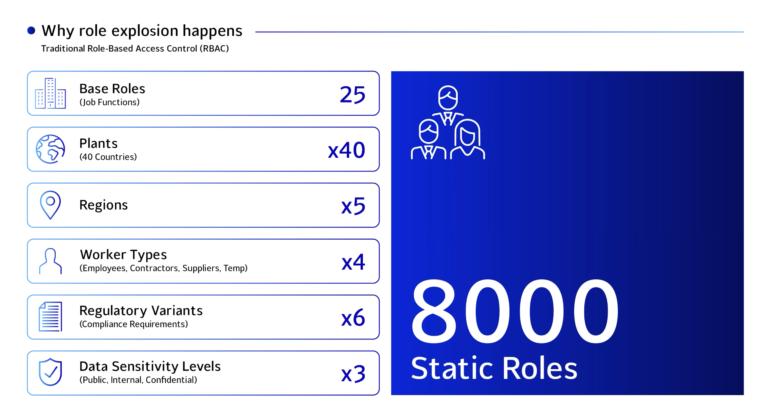
For example, a global manufacturing enterprise operating in 40 countries relying heavily on traditional role-based access control to manage access across ERP, supply chain, and manufacturing systems.

Over time, the organization accumulated more than 8,000 roles as new requirements were introduced for:

  • Different plants and regions
  • Contractors and suppliers
  • Temporary project access
  • Regulatory restrictions
  • Sensitive production data

This made access reviews and audits more difficult to complete. Users were often overpermissioned and security teams struggled to maintain least-privileged access across systems.

A diagram showing how roles multiple in an organization

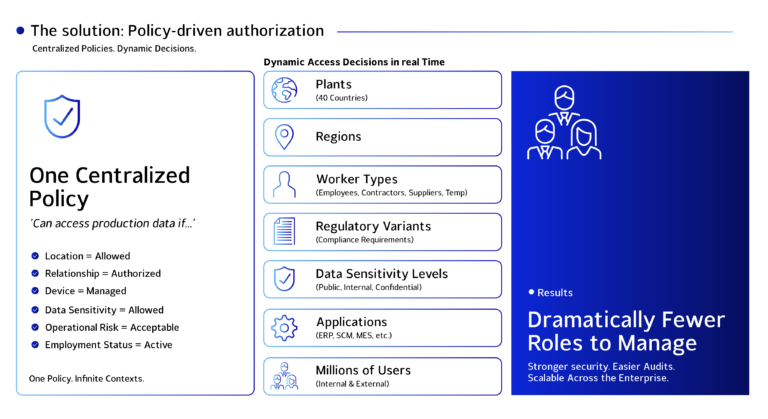
To solve the problem, the enterprise implemented a centralized, policy-driven authorization solution. This reduced the amount of roles being created by enabling real-time access decisions based on attributes such as:

  • Location
  • Relationship
  • Device
  • Data sensitivity
  • Operational risk level

As a result, the company significantly reduced the number of roles they needed to manage while improving consistency, scalability and security across global operations.

Business Outcomes

From Complexity to Control

Policy-driven authorization enables organizations to move beyond the limitations of traditional RBAC by making access decisions based on business context rather than an ever-growing number of roles.

Improved Security

Enforce least-privilege access with fine-grained policies that consider real-time context, reducing the risk of excessive permissions.

Lower Admin Costs

Minimize the effort required to create, manage, and audit large numbers of roles, freeing security and IT teams to focus on higher-value initiatives.

Faster Business Agility

Support new users, applications, partners, and business requirements without introducing additional role complexity.

Stronger Compliance & Governance

Demonstrate consistent, auditable access controls across systems while simplifying compliance reporting and policy reviews.

FAQs

Role explosion is the rapid growth of roles within a role-based access control (RBAC) system as organizations add new users, applications, business units, and access requirements. Excessive roles increase administrative complexity, make audits more difficult, and can lead to security and compliance challenges.

No. Policy-driven authorization uses roles as one of many attributes in an access decision, alongside factors such as user characteristics, resource sensitivity, location, and risk. By evaluating these conditions at runtime, organizations can simplify and reduce the number of roles needed while achieving more precise, context-aware access control.

Role explosion occurs when organizations continuously create new roles to accommodate changing business requirements, applications, users, locations, projects, and compliance mandates. Over time, the number of roles becomes difficult to manage, audit, and govern.

Role-based access control (RBAC) grants access based on predefined roles, while attribute-based access control (ABAC) evaluates attributes about users, resources, actions, and environmental conditions. ABAC provides greater flexibility and helps eliminate the need for excessive role creation.

Common indicators include:

  • Hundreds or thousands of roles across systems
  • Frequent requests to create new roles
  • Difficulty understanding role assignments
  • Lengthy access reviews and audits
  • Challenges implementing least-privilege access
  • Slow response to changing business requirements

Request a Demo

Take the Next Step in Securing Your Enterprise Systems

Schedule a meeting with our experts to discover how the Axiomatics Authorization Management Platform helps you implement fine-grained access control, support Zero Trust, and meet today's security and compliance requirements.

Explore More Content

Product

Explore the Platform Capabilities Behind Secure, Scalable Authorization

This website uses cookies

Cookies consist of small text files. They contain data that is stored on your device. To enable us to place certain types of cookies we need to obtain your consent. At , corp. ID no. , we use the following kinds of cookies. To read more about which cookies we use and storage times, click here to access our cookies policy.

Manage your cookie-settings

Necessary cookies

Check to consent to the use of Necessary cookies

Nödvändiga cookies

Cookie Syfte Lagringstid
consents

Används för att hantera samtycke

1 år
__hssrc

Närhelst HubSpot ändrar sessionscookien, ställs denna cookie också in för att avgöra om besökaren har startat om sin webbläsare.

Session

Functional cookies

Check to consent to the use of Functional cookies

Funktionella cookies

Cookie Syfte Lagringstid
messagesUtk

För att lagra webbläsarinformation och utförda åtgärder på webbplatsen.

6 månader

Cookies for statistics

Check to consent to the use of Cookies for statistics

Cookies för statistik

Cookie Syfte Lagringstid
__hssc

För att lagra anonymiserad statistik.

30 minuter
_gcl_au

För att lagra och spåra konverteringar.

3 månader


Personalization cookies

Check to consent to the use of Personalization cookies
In order to provide a better experiance we place cookies for your preferances

Cookies for ad-tracking

Check to consent to the use of Cookies for ad-tracking

Cookies för annonsmätning

Cookie Syfte Lagringstid
__hstc

För att lagra besökstid.

6 månader
hubspotutk

För att lagra och spåra en besökares identitet.

6 månader


Ad measurement user cookies

Check to consent to the use of Ad measurement user cookies
In order to show relevant ads we place cookies to tailor ads for you

Personalized ads cookies

Check to consent to the use of Personalized ads cookies
To show relevant and personal ads we place cookies to provide unique offers that are tailored to your user data