

Policy-based access management (PBAM) is an approach to managing and enforcing access control through centrally defined authorization policies. These policies determine whether users, applications, and services can access specific resources or perform certain actions based on business rules and security requirements.
While other forms of access control, such as role-based access control (RBAC), grants permission based on the roles of a user (i.e the Manager has access to all documents in an organization while a Sales Team Member does not) PBAM provides access control through the use of policies. With PBAM, access is granted only to users who meet certain criteria. For example, maybe you only want your employees to access company data during their working hours and from work issued devices.
PBAM makes it possible to enforce permissions dynamically using policies that consider attributes such as user identity, device, location, and risk level — safeguarding critical data and reducing the risk of hackers moving laterally within the organization.
How Does PBAM Work?
Policy-based access management evaluates access requests against predefined authorization policies to determine whether an action should be permitted or denied.
Rather than relying exclusively on a user's assigned role, PBAM can consider additional information about the requested resource, the action being performed, and the conditions surrounding the request.
The process generally follows five steps:
- An access request is made. A user, application, or service attempts to access a protected resource or perform an action.
- Relevant information is collected. The authorization system receives information about the requesting identity, resource, action, and context. Additional attributes may be retrieved from trusted sources.
- Applicable policies are evaluated. A Policy Decision Point (PDP) evaluates the request against the organization's authorization policies.
- An authorization decision is returned. The PDP determines whether the request satisfies the applicable policies and returns a decision.
- The decision is enforced. A Policy Enforcement Point (PEP) allows or denies the requested action according to the authorization decision.
This approach enables organizations to manage authorization policies consistently while evaluating access requests using relevant business and security context.
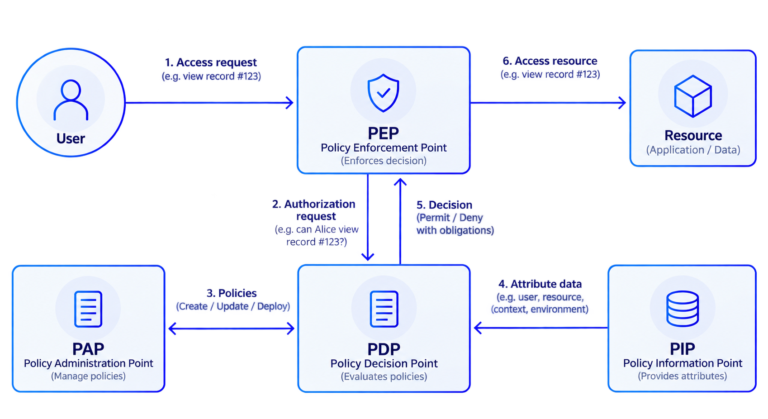
Key Components of PBAM Architecture
A policy-based access management architecture typically separates policy administration, decision-making, and enforcement. This allows organizations to manage authorization requirements centrally while integrating access decisions into different applications and services.
The main components include:
- Managing policies via Policy Administration Point (PAP)
- Storing policies via Policy Repository Point (PRP)
- Policy decisions at run-time via PDP
- Additional information context via Policy Information Point (PIP) used by the PDP
- Integration via Policy Enforcement Point (PEP)
- Cloud-native environments can easily take advantage of flexible configuration options such as using API’s or configuration files. They also benefit from technologies such as Kubernetes by leveraging their built-in fault tolerance and scalability features.
PBAM Deployment Options
PBAM solutions can be deployed using different architectures depending on an organization's security, performance, and operational requirements.
Common deployment options include on-premises infrastructure, cloud environments, containers, and Kubernetes-based platforms. Authorization decision services may be deployed centrally or distributed closer to the applications they protect.
Organizations should consider application integration requirements, decision latency, availability, scalability, and access to contextual data when selecting a deployment approach.
What Are the Benefits of PBAM?
Policy-based access management helps organizations modernize access control by replacing fragmented, application-specific authorization rules with consistent, centrally managed policies.
Key benefits include:
- Centralized policy management: Define, update, and maintain authorization policies across applications and services without duplicating business rules in each system.
- Fine-grained access control: Make decisions based on user roles, resource attributes, requested actions, and contextual information rather than relying solely on broad permissions.
- Dynamic authorization: Evaluate relevant conditions at runtime to determine whether access should be permitted.
- Reduced entitlement complexity: Use reusable policies to reduce the need for numerous specialized roles and individually assigned permissions.
- Improved security and compliance: Support least privilege, consistent policy enforcement, and authorization decision logging to strengthen governance and auditability.
- Greater operational flexibility: Adapt authorization policies as business requirements, regulations, and organizational responsibilities change.
By managing authorization through policies, organizations can reduce administrative complexity while maintaining greater control over access to sensitive resources.
What's the Difference Between PBAM, PBAC, ABAC, and RBAC?
Policy-based access management (PBAM), policy-based access control (PBAC), attribute-based access control (ABAC), and role-based access control (RBAC) are closely related concepts, but they describe different aspects of authorization.
PBAM focuses on managing and governing access through policies across enterprise systems. PBAC describes enforcing access decisions using defined policies, while ABAC and RBAC describe different ways of determining permissions.
These approaches are not mutually exclusive. For example, a PBAM solution can use both role information and contextual attributes when evaluating authorization policies.
| Approach | Primary focus | How it works |
| PBAM | Enterprise authorization management | Manages, governs, and enforces access through policies |
| PBAC | Policy-driven access decisions | Evaluates defined policies to permit or deny actions |
| ABAC | Attribute-based decisions | Evaluates subject, resource, action, and environmental attributes |
| RBAC | Role-based permissions | Assigns permissions based on roles associated with identities |
PBAM Example
Consider a financial institution where employees across different departments need access to customer accounts, financial records, and sensitive transaction information.
Traditionally, access may be managed through predefined roles and individual permissions. As employees change responsibilities, work across departments, or require temporary access, maintaining these permissions can become increasingly complex.
With policy-based access management, the institution can define authorization policies that consider an employee's responsibilities, relationship to a customer, the sensitivity of the requested information, and the action being performed.
When an employee requests access, the authorization system evaluates the relevant policies and contextual information to determine whether the request should be permitted.
For example, an employee may be authorized to view customer account information but restricted from approving certain transactions without additional authority.
As business requirements change, the institution can update its authorization policies centrally rather than manually adjusting numerous individual permissions across applications.
This approach helps organizations enforce consistent access requirements, reduce administrative overhead, and support least-privilege access across enterprise systems.
How PBAM aligns with Zero Trust Architecture
Zero Trust is a security approach built on the principle that access should be explicitly verified rather than automatically trusted based on network location or previous authentication.
Policy-based access management supports Zero Trust by enabling organizations to evaluate access requests against defined authorization policies.
With PBAM, organizations can:
- Enforce least privilege: Limit access to the resources and actions required for a specific task.
- Evaluate contextual information: Consider identity, device posture, location, resource sensitivity, and other relevant conditions.
- Apply consistent access controls: Enforce shared authorization requirements across applications, APIs, and services.
- Adapt to changing requirements: Update policies as security risks, business responsibilities, and access requirements evolve.
- Improve visibility: Support authorization decision logging and policy governance.
By combining authentication with fine-grained, policy-driven authorization, organizations can implement more consistent access controls across their Zero Trust architecture.
PBAM Standards and Interoperability
Authorization standards play an important role in policy-based access management (PBAM), helping organizations implement consistent access controls across diverse applications and services while reducing reliance on proprietary integrations.
Several standards and initiatives support PBAM:
- eXtensible Access Control Markup Language (XACML): An OASIS standard that defines an authorization policy language, request and response format, and reference architecture for policy-based access control.
- Abbreviated Language for Authorization (ALFA): A language that simplifies the creation and maintenance of authorization policies by providing a more intuitive, less verbose syntax than XACML. ALFA policies can be translated into XACML.
- OpenID AuthZEN: An OpenID Foundation working group focused on standardizing how applications communicate with authorization decision services to improve interoperability across enterprise environments.
Axiomatics solutions support standards-based authorization using XACML and ALFA, enabling organizations to define, manage, and maintain fine-grained access policies. Whether working with ALFA or XACML, organizations can benefit from centralized policy management, simplified policy development, and flexibility as their authorization requirements evolve.
Axiomatics is also a founding member of the OpenID AuthZEN Working Group, with our CTO, David Brossard, serving as chair. The group's work aims to establish standardized interfaces between applications and authorization services, making it easier to integrate policy-based authorization across different technologies and environments.
By adopting standards-based PBAM solutions, organizations can improve interoperability, maintain greater flexibility, and reduce the risk of vendor lock-in as their authorization needs grow.
Axiomatics and PBAM
The Axiomatics Authorization Management Platform helps organizations manage and enforce fine-grained authorization policies across applications, APIs, data, and AI systems.
By separating authorization policy management, decision-making, and enforcement, Axiomatics enables organizations to apply consistent access requirements while supporting complex business rules and contextual access decisions.
Whether you're modernizing legacy access controls, reducing role explosion, or implementing Zero Trust, Axiomatics provides the tools to build and manage a scalable, policy-driven authorization strategy.