

A policy enforcement point (PEP) is a component of an authorization architecture responsible for intercepting access requests and enforcing authorization decisions made by a policy decision point (PDP). It acts as the enforcement layer between users or services requesting access and the resources they want to access.
When an access request occurs, the PEP sends the relevant information to the PDP for evaluation. The PDP determines whether access should be permitted or denied based on applicable authorization policies, and the PEP enforces that decision.
PEPs can be implemented within applications, AI ecosystems, APIs, microservices, API gateways, and other points where access control is required. By separating policy enforcement from policy evaluation, organizations can apply consistent authorization requirements without embedding complex authorization logic throughout their applications.
How does a PEP work?
A Policy Enforcement Point works alongside a Policy Decision Point to ensure that access requests are evaluated and enforced according to defined authorization policies.
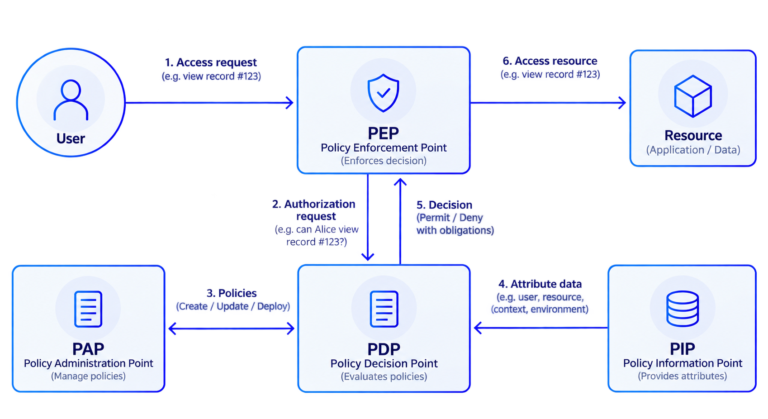
The process generally follows six steps:
- Access request: A user, application, or service requests access to a protected resource.
- Request interception: The PEP intercepts the request and communicates the authorization requirements to the PDP.
- Context collection: The policy engine evaluates relevant information, such as user identity, device posture, resource attributes, and environmental conditions, using available data sources.
- Policy evaluation: The policy engine evaluates the request against applicable authorization policies and determines whether access should be permitted or denied.
- Decision communication: The policy administrator communicates the decision to the PEP and provides instructions for establishing or denying access.
- Policy enforcement: The PEP enforces the decision by allowing or blocking access to the protected resource. It can also monitor and terminate established connections when required.
For example, when an employee attempts to access a confidential financial report, the PEP intercepts the request and asks the PDP whether access should be permitted. The PDP evaluates the employee's attributes, the sensitivity of the report, and other relevant conditions before returning a decision.
The PEP then enforces that decision, ensuring the employee can access the report only when the authorization requirements are satisfied.
Key features of PEPs
PEPs play an important role in enforcing authorization policies across applications, APIs, and distributed environments. Key capabilities include:
- Real-time authorization enforcement: PEPs enforce authorization decisions when access is requested, ensuring that actions comply with the applicable policies.
- Separation of policy decisions and enforcement: PEPs delegate policy evaluation to PDPs, reducing the need to embed authorization logic directly into applications.
- Fine-grained access control: PEPs can enforce decisions based on detailed policies that consider user attributes, resource sensitivity, requested actions, and contextual information.
- Support for Zero Trust: PEPs help enforce Zero Trust principles by applying authorization decisions based on available identity, device, and environmental context.
- Flexible deployment: PEPs can be integrated into applications, APIs, microservices, gateways, and other enforcement locations across cloud and on-premises environments.
- Consistent authorization enforcement: When integrated with centrally managed authorization policies, PEPs help organizations apply consistent access requirements across distributed systems.
What is the difference between a PEP and PDP?
The primary difference between a PEP and a PDP is their role in the authorization process. The PDP evaluates authorization policies and makes access decisions, while the PEP enforces those decisions.
| PEP | PDP | |
| Primary responsibility | Enforces authorization decisions | Evaluates policies and makes decisions |
| Role in authorization | Intercepts requests and controls access | Determines whether access should be permitted |
| Policy evaluation | Typically delegates evaluation to the PDP | Evaluates applicable authorization policies |
| Typical location | Applications, APIs, gateways, and services | Centralized or distributed authorization service |
| Decision output | Allows or blocks the requested action | Returns Permit, Deny, or another supported decision |
| Relationship | Requests and enforces decisions | Provides decisions to enforcement points |
PEPs and PDPs work together to separate authorization logic from application enforcement. This enables organizations to manage policies independently while applying decisions wherever access control is required.
PEP Example
Consider a healthcare organization where clinicians need access to patient records while maintaining strict privacy and security requirements.
When a clinician attempts to open a patient's medical record, the application uses a PEP to request an authorization decision from the PDP.
The PDP evaluates the applicable policies using information such as:
- User: The clinician's identity and assigned role.
- Resource: The patient's medical record.
- Action: View or modify the record.
- Context: The clinician's relationship to the patient and other relevant access conditions.
If the clinician meets the authorization requirements, the PDP returns a Permit decision, and the PEP allows access. If the clinician does not meet the requirements, the PDP returns Deny, and the PEP blocks the request.
This approach allows healthcare organizations to enforce fine-grained access controls while keeping authorization policies separate from application code.
PEPs with Axiomatics
Axiomatics enables organizations to implement fine-grained, policy-driven authorization by separating authorization decisions from enforcement.
With the Axiomatics Authorization Management Platform, the PEP communicates with Axiomatics' PDP to obtain an authorization decision based on the applicable policies and available contextual information.
This approach helps organizations:
- Externalize authorization logic: Separate policy evaluation from application code, simplifying authorization management.
- Enforce fine-grained access controls: Apply decisions based on user attributes, resource information, requested actions, and contextual conditions.
- Maintain consistent enforcement: Use centrally managed policies to support consistent authorization decisions across applications and services.
- Adapt to changing requirements: Update authorization policies without modifying the enforcement logic in every application.
- Support Zero Trust architecture: Enforce context-aware authorization decisions at relevant access points.
By combining centralized policy management with distributed enforcement, Axiomatics helps organizations apply consistent authorization controls across complex enterprise environments.