

With traditional authorization implementations, information and application access policies are typically hard coded into the application. As system requirements evolve, this approach can quickly become difficult to manage, introducing several challenges such as duplicated authorization logic, policy updates that require code redeployment, inconsistent enforcement of access control, and limited visibility into how authorization decisions are evaluated.
Externalized authorization, or externalized authorization management (EAM), runs on the approach that access control logic should be decoupled from application code based on the function it serves. Rather than hard-coding authorization checks into each application, authorization decisions are delegated to a specialized service acting as a Policy Decision Point (PDP). The PDP evaluates each request against centrally managed policies to determine a user’s access rights.
This approach separates the management of access control policies from the application development lifecycle. By introducing a dedicated control plane, externalized authorization addresses the limitations of traditional, embedded authorization decisions across systems. In essence, it reduces the need to touch application code every time there is a business, regulatory or internal change allowing for runtime authorization.
How externalized authorization works
Centralizing access control lets you make real-time access decisions using a centrally managed PDP. It leverages user attributes, stored in your identity system or provided by tokens, attributes of the resource or information being accessed and authorization policies to decide when users should be granted access.
The reference architecture below illustrates a typical externalized authorization implementation using standard components.
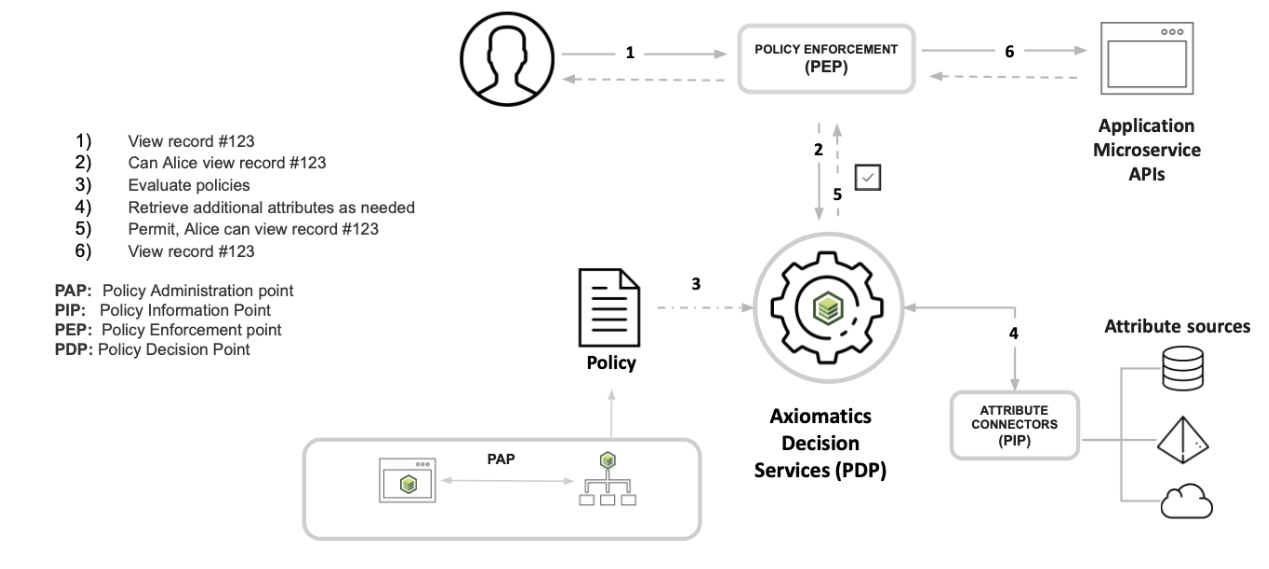
The externalized authorization architecture differs based on the application and the type of resource being targeted (for example, a sidecar PDP in a microservices environment), and is flexible enough to support modern DevSecOps-driven deployment models.
What are the benefits of externalized authorization?
By having access policies centralized, it allows for more efficient use of resources. Externalized authorization further extends these advantages by providing several key benefits:
-
- Simplifies compliance requirements, audits, and access reviews: Centralized authorization simplifies compliance by giving teams a single place to track and audit external access policies. By moving policy evaluation and logging to a specialized managed authorization service , organizations gain clear insights into authorization decisions, making audit faster and more reliable.
- Allows faster onboarding for new application programming interfaces (APIs): This reduces time to value by providing a consistent, repeatable authorization model. By standardizing how APIs register, enforce policies, and emit logs, teams can integrate new services with minimal custom work, enabling developers to ship securely without reinventing access controls for each API.
- Provides agile, more loosely-coupled, flexible architecture: Modern applications often require complex, context-aware authorization decisions. Externalized authorization operates independently of any single application, enabling it to leverage additional context from the environment, upstream or downstream services or other relevant attributes to make informed decisions. This is especially valuable because applications themselves may not always have all the necessary context. An externalized authorization service can connect to a wide variety of data sources to enrich user or resource information, ensuring accurate and context-aware access control.
- Creates consistent & coherent policy enforcement: Instead of depending on individual system administrators, organizations can manage access policies across all systems from a single, central control point. Externalized authorization lets policies be defined and maintained in one place, preventing inconsistencies that occur when each application manages authorization separately. Updates can be applied centrally and take effect across all systems without modifying application code.
- Enables policy-driven authorization: By externalizing access decisions, policy-driven authorization allows fine-grained control over resources, using user attributes and contextual policies to enforce the principle of least privilege.
- Saves development time: Externalized authorization allows development teams to focus on key initiatives rather than writing extensive code to handle complex access requirements. By moving authorization out of individual applications, developers can reuse common blocks anywhere access control is required. Platform engineering teams can amplify their impact by creating shared policy snippets and library functions. Centralizing policies reduces code complexity and lowers the risk of security vulnerabilities introduced during development
- Scales access control: As applications grow, embedding authorization logic in every service quickly becomes difficult to maintain and scale. Externalized authorization centralizes policy enforcement, ensuring consistent access control across microservices, APIs, and distributed systems without duplicating or hard-coding logic in each component.
Externalize authorization with Axiomatics
Externalized authorization is a powerful way to strengthen access control across your organization. At Axiomatics, our experts can help you confidently scale authorization policies across your organization with externalized authorization.