


Large Language Models (LLMs) are quickly becoming embedded in enterprise workflows, but they also introduce new security risks. From prompt injection to data leakage, AI systems blur the lines between user input, application logic, and data access in ways traditional access controls weren’t designed to handle.
The Open Worldwide Application Security Project (OWASP) LLM Top 10 highlights these merging risks, but addressing them requires more than patching individual vulnerabilities. It requires rethinking how access is controlled across AI-driven systems.
This is where policy-driven authorization comes in. By enforcing fine-grained, context-aware decisions at runtime, it acts as a consistent guardrail ensuring that even if an LLM behaves unpredictably, it can’t access or act on anything it shouldn’t.
Why traditional access control models fail for LLM and AI systems
Traditional access control models like role-based access control (RBAC) or static scopes with token based models were already struggling to keep up with the complexity of modern enterprise systems. AI simply exposes those limitations more clearly.
RBAC relies on static, broad permissions that don’t translate well to AI-driven workflows, where access decisions need to be fine-grained and context-aware. It also lacks robust ways to handle delegation, making it difficult to securely manage AI agents acting on behalf of users. On top of that, many systems don’t treat AI agents as distinct identities, creating gaps in both enforcement and visibility.
To keep pace, organizations need to move beyond static roles and adopt policy-driven, runtime authorization that evaluates every action in context.
What is policy-driven authorization (and why it matters for AI security)
Policy-driven authorization is an approach to access control where every action, whether initiated by a human or an AI agent, is evaluated against centrally defined policies at runtime. Instead of relying on static roles or hard-coded permissions, policies define who, can do what, on which resource, under what conditions. These decisions are made dynamically using real-time context such as user identity, intent, data sensitivity, and environmental factors.
How policy-driven authorization mitigates the OWASP LLM Top 10 risks
LLM01: 2025 Prompt Injection
A prompt injection vulnerability occurs when created inputs manipulate an LLM into changing its behavior or producing unintended outputs. These inputs don’t need to be obvious or even human-readable if the model can parse them, they can influence its decisions. This makes it possible for attackers to override instructions, bypass safeguards, or trigger unauthorized actions without the manipulation being visible to a user.
Policy-driven authorization helps by controlling the subsequent tool calls and actions or even the payload generated. It also introduces another level of intent identification using an independent LLM/Small Language Model (SLM) to further mitigate the risk. Even if a prompt injection attempts to manipulate the model’s behavior, those requests are independently verified and blocked if they fall outside allowed permissions, effectively restricting the model’s access to the minimum necessary for its intended operations.
LLM02:2025 Sensitive Information Disclosure
Sensitive information disclosure occurs when an LLM exposes confidential or restricted data in its responses, often through connected systems, tools, or retrieved context. Because models can combine information from multiple sources during generation, they may inadvertently surface data the user is not authorized to access if proper controls are not enforced. This risk is especially significant in agentic workflows where a single prompt can trigger multiple downstream data requests across systems.
Policy-driven authorization mitigates sensitive information disclosure by ensuring data is only accessed and returned when explicitly allowed by policy. This ensures only authorized data can ever be used in LLM responses.
Key enforcement points include:
- Pre-access checks on data retrieval:Every request to a database, API, or knowledge source is validated before data is returned. This prevents unauthorized information from ever entering the model’s context window.
- Fine-grained access control: Policies restrict not just which systems can be accessed, but exactly which records, fields, or attributes are visible to a given user or agent.
- Context-aware filtering at runtime: Access decisions incorporate identity, role, purpose, and session context, ensuring that the same query can yield different results depending on who or what is asking.
Together, these controls ensure sensitive data is only exposed when it is explicitly authorized.
LLM05:2025 Improper Output Handling
Improper output handling occurs when LLM-generated responses are treated as trusted without validation or sanitization before being passed to downstream systems. Because model outputs can be influenced by prompt input, this effectively gives users indirect control over additional functionality, mostly by supplementing prompts from other sources, the output can be filtered or masked based on policy decisions and by only trusting verified sources. If unchecked, this can lead to unintended actions, security bypasses, or system compromise. The risk is especially high in automated or agent-driven workflows where outputs directly trigger operations.
Policy-driven authorization mitigates improper output handling by treating the model as any other user in a Zero Trust architecture. Instead of assuming against policy before it is allowed to proceed. This ensures the model only performs actions it’s explicitly authorized to take, regardless of how the output was generated.
LLM07:2025 System Prompt Leakage
System prompt leakage refers to the risk that system prompts can be used to steer the behavior of the model to access sensitive information that was not intended to be discovered, such as access patterns, credentials, or operational logic. If discovered, this information can be used to facilitate further attacks, such as prompt injection or unauthorized access. This makes the system prompts a high-risk area where sensitive data can be inadvertently embedded and later revealed.
System prompt leakage becomes far less impactful when policy-driven authorization is enforced as a guardrail as even if a prompt is "leaked," the underlying data or actions it refers to remain protected by real-time validation. This approach ensures that even if a system prompt is exposed or manipulated, it does not grant additional access or reveal sensitive information that the end user isn’t allowed to see. Every retrieval or action still requires a policy check based on user, agent, and context, preventing authorized data from ever being returned.
LLM08:2025 Vector and Embedding Weaknesses
Vector and embedding weaknesses present risks in systems using Retrieval-Augmented Generation (RAG), where LLMs rely on vector databases to retrieve context. Because retrieval is based on semantic similarity rather than strict access controls, users may receive information that is relevant, but they are not authorized to see. Weaknesses in how embeddings are generated, stored, or retrieved can also be exploited to inject harmful content or manipulate model outputs. This makes it difficult to predict, control, and audit what data is surfaced, increasing the risk of unintended exposure or misuse.
Policy-driven authorization mitigates vector and embedding weaknesses in RAG systems by enforcing security at both retrieval and data-layer levels. Instead of relying on semantic similarity alone, every query, embedding store, and retrieved result is governed by fine-grained access control.
Key enforcement points include:
- Permission and access control: Apply fine-grained, attribute-based controls to vector and embedding stores, ensuring strict logical partitioning of datasets so users and agents can only access authorized data.
- Data classification: Apply policy checks when combining datasets to prevent cross-sensitivity leaks or incorrect data mixing.
- Auditability: Maintain detailed logs of retrieval activity to detect anomalies, investigate access patterns, and respond to suspicious activity in real time.
Together, these controls ensure that RAG systems remain both contextually powerful and securely constrained by policy.
Overview: Traditional vs. Policy-driven authorization
This comparison illustrates a key shift: from static, role-based controls to runtime, context-aware authorization that governs every AI interaction across prompts, tools, and data sources.
| Risk (OWASP LLM Top 10) | Traditional Controls | Policy-driven authorization |
| Prompt Injection | Input filtering, prompt sanitization, or model guardrails | Runtime authorization of every tool call, API request, and action based on user and agent context |
| Sensitive Data Exposure | Network perimeter controls, coarse RBAC, database-level permissions | Fine-grained, attribute-based access control applied at data retrieval and field/record level before data enters the model context |
| Improper Output Handling | Output filtering or post-processing validation after generation | Action-level authorization ensuring LLM outputs cannot trigger unauthorized downstream operations |
| System Prompt Leakage | Hidden prompts, static prompt protection, and obfuscation | Policy enforcement ensures system instructions never grant additional access or expose restricted data even if revealed or manipulated |
| Vector and Embedding Weaknesses | Index-level security, isolated vector databases, or coarse dataset separation | Policy-controlled retrieval with per-query authorization, embedding-level access rules, and dataset partitioning based on identity and context |
Where policy-driven architecture fits in an AI system
The diagram below highlights where traditional access control begins to break down and where policy-driven, runtime authorization becomes essential.
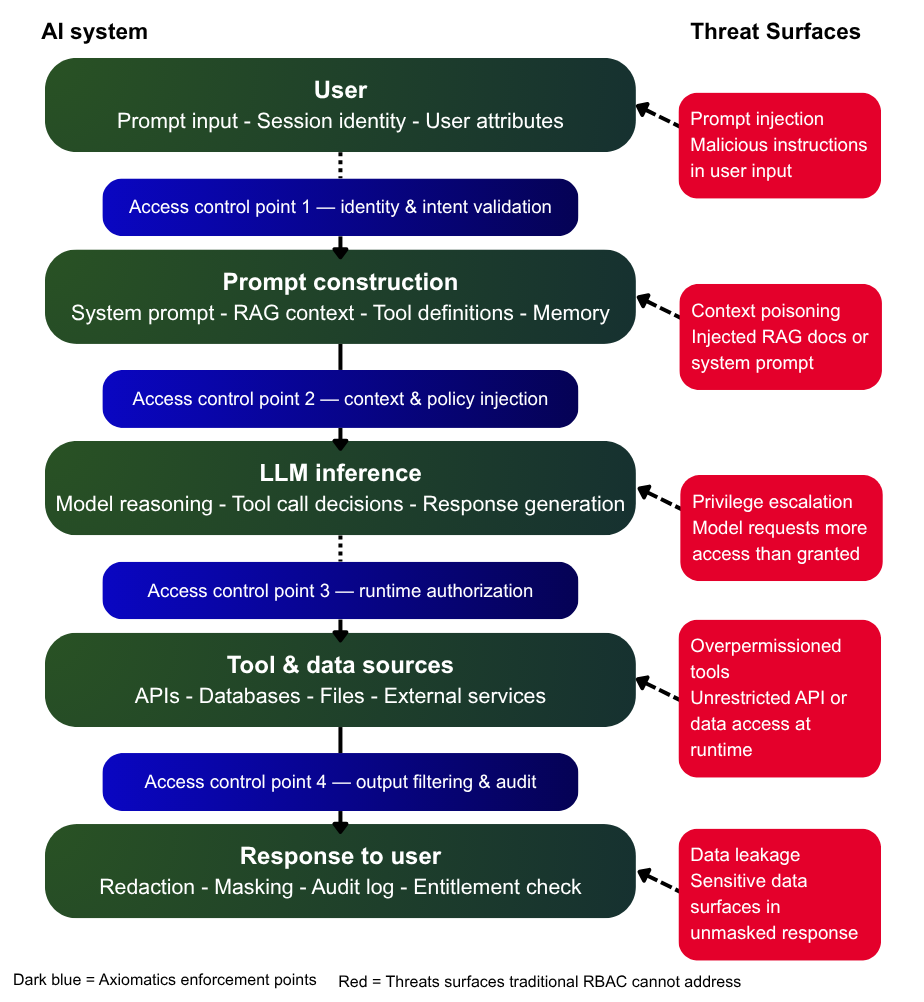
In a conventional application, identity is checked once at login and permissions are assigned based on roles. From that point on, access decisions are largely static and tied to the user’s role within the system.
In AI systems, that model no longer holds.
The boundary between “who is asking” and “what is being executed” becomes blurred. A prompt can carry injected instructions. A RAG document can rewrite the system prompt. The model itself can decide to call tools or access data beyond what the user was supposed to have. By the time a response is generated, sensitive data from multiple sources may have blended into a single text stream that bypasses any row-level or field-level controls that existed in the underlying databases.
This is why identity must move from a one-time check to a continuous, policy-driven process.
In the diagram, the four enforcement points (highlighted in teal) show where runtime authorization can be applied across the AI pipeline:
- Request validation: Verify identity, role, and intent before the request is processed
- Prompt construction: Inject policy context to ensure only authorized data is included
- Tool and data access: Enforce authorization on every runtime call the model makes
- Response filtering and auditing: Inspect and log outputs before they reach the user
Together, these controls ensure that access decisions are made dynamically and consistently even as context, intent, and system behavior evolve in real time.
Conclusion
The risks outlined in the OWASP LLM Top 10 all point to the same underlying challenge: AI systems introduce new paths to data and actions that traditional access controls can’t reliably govern. Whether it’s prompt injection, data leakage, or unsafe outputs, the common failure point is a lack of consistent, runtime enforcement.
Policy-driven authorization closes that gap by acting as a deterministic guardrail to access the entire AI workflow. By evaluating every action — across prompts, agents, tools, and data — against fine-grained policies, it ensures that access is always contextually allowed at that moment.
If you want to learn more about securing AI, we recommend the following guides:
- How authorization fits in the OWASP MCP top 10
- Secure your AI agents and MCP gateways with policy-driven authorization (webinar)
- Secure your RAG: Where to start?
If you have additional questions or would like to see a demo, please reach out to us and our solution experts would be happy to connect with you.
FAQ
What is the biggest security risk in LLM systems?
The biggest security risk in LLM systems is unauthorized access to data or actions through indirect model behavior, rather than traditional system compromise. This includes issues like prompt injection, sensitive data exposure through retrieval systems, and unsafe tool execution.
How is policy-driven authorization different from RBAC?
Role-based access control (RBAC) assigns broad, static permissions based on predefined roles, which works well for traditional applications but breaks down in dynamic AI workflows.
Policy-driven authorization is fundamentally different because it evaluates every action at runtime using fine-grained policies and real-time context.
Key differences include:
- Role-based: Static roles and pre-assigned permissions
- Policy-driven: Dynamic decisions based on identity, context, data sensitivity, and intent
- Role-based: Coarse-grained access at the system or application level
- Policy-driven: Fine-grained control over individual actions, data fields, and tool calls across AI systems
This makes policy-driven authorization better suited for LLMs and agentic AI, where access decisions must be continuously evaluated.
Can LLMs enforce their own security controls?
No. LLMs should not be responsible for enforcing their own security controls.
While models can be instructed to follow rules, they are inherently probabilistic systems and can be influenced by prompt injection, adversarial inputs, or ambiguous instructions. This makes them unreliable as enforcement points.
Security must be enforced externally through deterministic systems such as policy-driven authorization. These systems evaluate every request, tool call, or data access outside the model, ensuring that even if the LLM is manipulated, it cannot exceed its permitted access or actions.
This article builds on concepts discussed in OWASP MCP Top 10, which is licensed under Creative Commons BY-NC-SA 4.0.
All interpretations, opinions, and solution approaches in this post are independently developed by Axiomatics.