


One of the most common questions I hear from identity or security teams when it comes to policy-driven authorization is about how to structure policies. On the whole, policy is a better way to express authorization (when compared to other methods such as access control lists) because of its expressiveness, ease of read/write, and audit. Specifically, we’re often asked whether the policy structure should be hierarchical or flat.
While it is possible to implement an external authorization solution leveraging either structure, understanding the nuances of each approach is vital, as it significantly impacts your security, flexibility, and scalability. So that’s what we’ll go through in this article.
So...what is a hierarchical policy framework?
Well, in short, it's a framework where policies are organized in a hierarchical manner, usually with overarching global policies at the top, followed by organizational policies, and then specific policies for individual applications or business units. This structure provides a clear delineation of authority and control while enabling efficient management of access policies across the enterprise.
Here is an example of a policy packaging structure taking into account hierarchy. It is important to keep in mind that there is endless flexibility to balance both central control and decentralized authoring to achieve both the security as well as business needs of the organization.
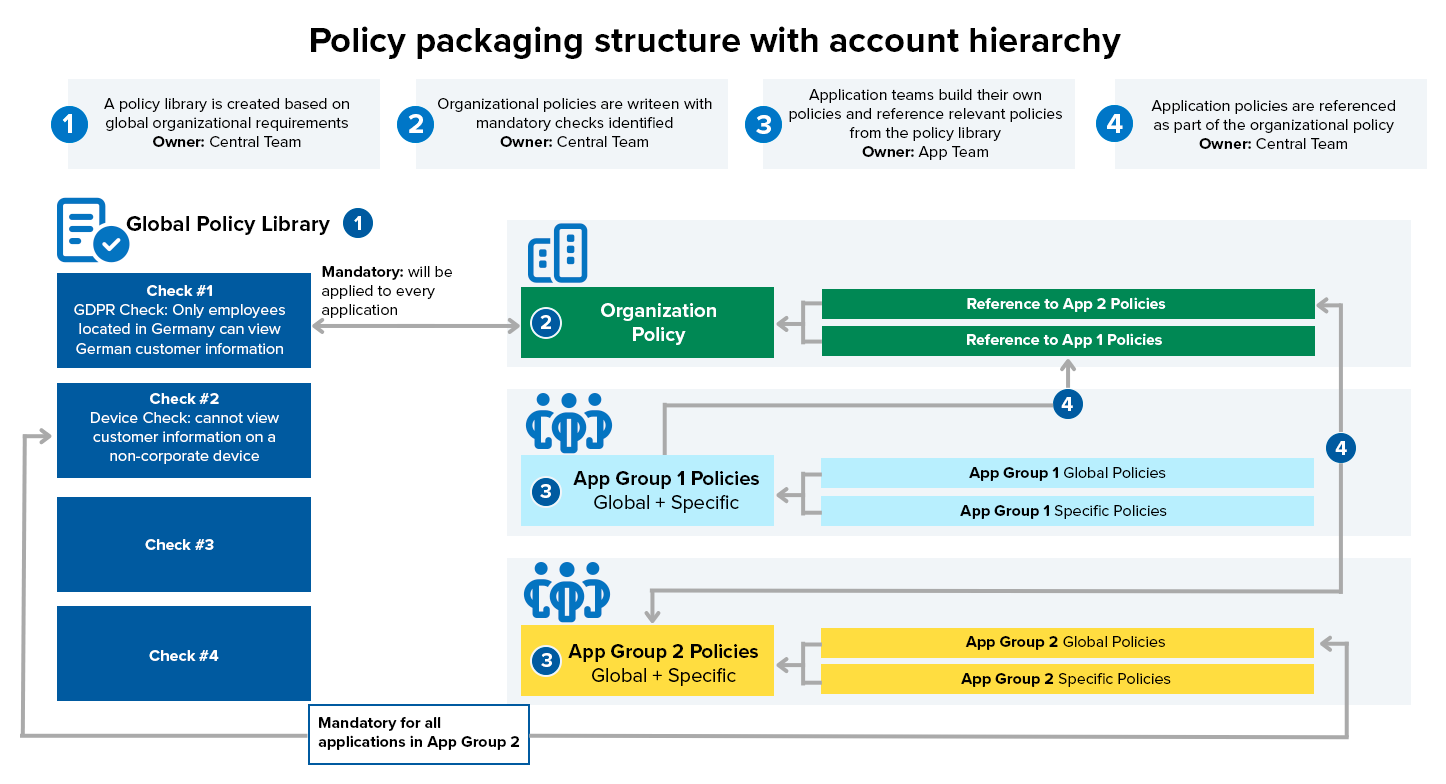
Let’s talk benefits
Let’s dive a bit deeper into why a hierarchical policy structure trumps a flat one. Here are the key benefits I see from enterprises using this approach:
Enhanced control and governance
A hierarchical policy structure gives you a greater level of control and governance. By establishing global policies at the top of the hierarchy, you ensure consistency and adherence to overarching security standards across all business units and applications. This centralized control means you mitigate the risk of unauthorized access and ensure compliance with regulatory requirements.
Flexibility and adaptability
Hierarchical policy structures offer greater flexibility, enabling you to tailor access policies to specific business needs and requirements. Because you can create and manage policies at different levels of the hierarchy, your internal stakeholders can easily adapt to evolving security landscapes, organizational changes, or new business initiatives. This agility is crucial to ensure your security and identity teams can respond quickly to emerging threats or opportunities.
Scalability and efficient collaboration
As your enterprise grows and evolves, your access policies will become more complex. A hierarchical policy structure gives you a scalable framework for effectively managing this complexity. By organizing policies into logical building blocks and leveraging a common taxonomy, you can streamline policy creation, maintenance, and enforcement. This not only improves operational efficiency but also reduces the risk of errors or inconsistencies, which pop up in a flat policy structure.
Clear separation of concerns
Hierarchical policy structures enable you to create a clear separation of concerns, allowing different teams or business units to manage their policies on their own, but within the broader enterprise framework. This decentralized approach empowers teams to make policy decisions that align with specific requirements and objectives while still adhering to overarching security guidelines set by central governance bodies. It fosters a sense of ownership and accountability, leading to more effective policy management and enforcement.
In the work we’ve done with enterprises in a variety of industries, one thing is clear - using a hierarchical policy strategy is critical for an efficient and successful approach to access policy management. This structure offers you the best of both worlds - it allows identity and security teams to establish clear, global policies while also letting individual teams create and manage their own specific policies within a structured framework. This is particularly important for any enterprise looking to strengthen their Zero Trust hygiene.
Ensuring global policies are enforced throughout the enterprise while enabling application - or API-specific policies creates multiple layers of complementary security instead of conflicting security policies (which take lots of time and resources to solve), minimizing both risk and user friction.
How Axiomatics fits into a hierarchical policy structure
Our comprehensive, policy-driven authorization solution aligns perfectly with the principles of hierarchical policy structures. Using our advanced capabilities, you can seamlessly implement and manage hierarchical access policies, ensuring you get the security, flexibility, and scalability you need across your entire ecosystem. Axiomatics also enables you to use ALFA, a language perfectly suited to a hierarchical policy structure, setting it apart from other common languages such as Rego or Cedar.
The choice between a hierarchical and flat policy structure can have significant consequences for your enterprise’s security posture and operational efficiency. By embracing the advantages of hierarchical policy structures and leveraging a policy-driven authorization solution, you can create a flexible, efficient, and secure approach to access control that minimizes risk and adheres to the principles of Zero Trust.
Your journey to a hierarchical policy structure starts now!
If you aren’t sure where to start with your policy structure or have questions based on what you’re doing today, reach out to our solution experts. In 30 minutes, our team can discuss:
- How we’ve worked with some of the world’s most well-known brands to solve their authorization challenges;
- Why those same companies continue to work with us; and
- How you can minimize risk, enable better collaboration and improve your Zero Trust strategy using our policy-driven authorization solution.