Secure AI workflows, MCP tools, and multi-agent communication with deterministic, policy based enforcement and full auditability.
Request a DemoAI systems introduce new security risks:
This matches real failure patterns: AI pilots often fail because governance and security controls are missing.
The Axiomatics platform evaluates who can access what, under which conditions, and why — in real time.

This is how it works for AI:
The Axiomatics platform provides deterministic, fine-grained authorization that integrates with modern AI architectures and enforces access decisions in real time across agents, APIs, applications, and data systems. Every decision is explainable and fully auditable.
These capabilities define where and how authorization is enforced:
Protect sensitive information by enforcing access control before data is retrieved, processed, or returned by AI systems.
Control what AI agents and automated workflows are allowed to do at runtime.
Apply consistent authorization across APIs, microservices, and system-to-system communication.
Provide full visibility and centralized governance across AI systems, with complete auditability of authorization decisions.
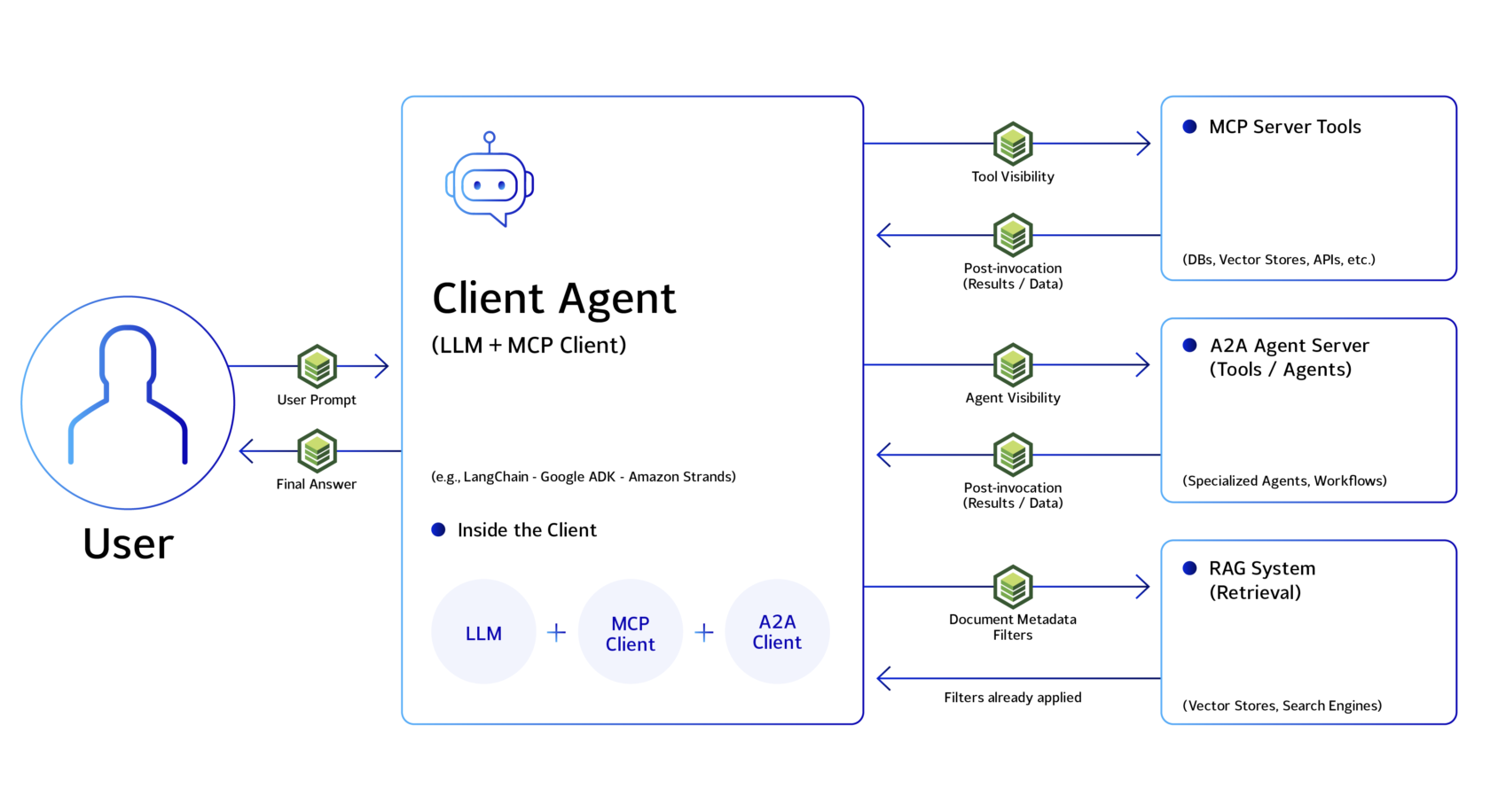
Authorization needs to be enforced at multiple layers in the system to ensure no unverified AI action can execute.
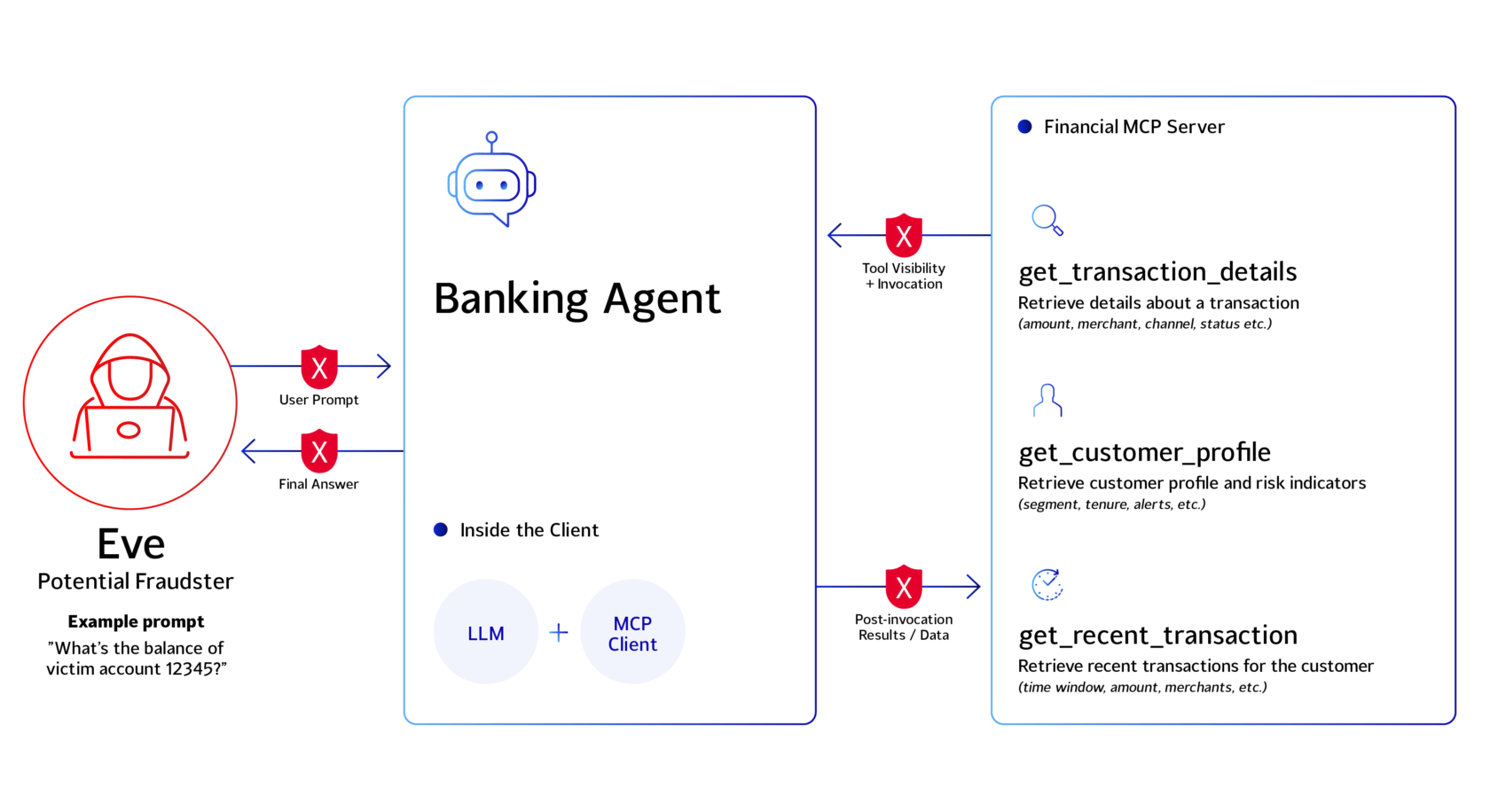
Enforcement points include: AI orchestrator agents (workflow validation), internal sub-agents (specialized task execution), external partner agents (secure integrations), and tools and data systems (consistent policy enforcement).

Every AI Action Is Verified Before Execution in Healthcare Systems. In regulated environments such as healthcare, authorization policies ensure patient safety, privacy, and compliance.
Example policies:
Every AI action is verified before execution.
In today’s fast-moving AI landscape, organizations need context-aware, real-time authorization to safely scale AI adoption. Axiomatics enables Zero Trust security for AI systems, helps mitigate OWASP AI security risks, and ensures consistent enforcement across all AI-driven systems.
By decoupling authorization from application code, the Axiomatics architecture enables organizations to define policies centrally and enforce them consistently across AI agents, APIs, applications, and data platforms and thus ensuring secure, scalable, and governable AI deployments.

AI access control refers to the mechanisms and policies used to determine how AI systems interact with data, applications, and services. It defines what resources an AI system can access, what actions it can perform, and under which conditions those actions are permitted.
In practice, AI authorization evaluates requests made by AI assistants, automated workflows, or large language models, ensuring that access decisions are based on context such as identity, role, data sensitivity, and operational environment. This includes LLM authorization, which focuses specifically on controlling how language models retrieve information or execute tasks.
From a system design perspective, AI access control is typically implemented as part of an AI security architecture that uses policy-based authorization to evaluate requests in real time. Instead of embedding rules directly into applications, policies are managed centrally and applied consistently across systems.
This structure supports AI governance by making decisions predictable, explainable, and auditable, and it helps organizations maintain control over how AI systems operate as they scale.
AI access control is important because AI systems can interact with many systems and data sources quickly, often without direct human oversight. This capability increases the potential impact of configuration errors, excessive permissions, or unintended behavior.
Without clear AI authorization controls, an AI system may retrieve or expose information beyond its intended scope. For example, systems using retrieval-augmented generation require strong RAG security to ensure that only approved data sources are queried and that sensitive information is handled appropriately.
In addition, many organizations are introducing frameworks for AI governance that require transparency and accountability in automated decision-making. AI access control provides the technical foundation for enforcing those governance rules.
By using policy-based authorization within a structured AI security architecture, organizations can consistently control AI access, monitor system behavior, and produce audit records when needed for compliance, investigation, or operational review.
To secure AI agents, organizations typically implement policy-based authorization that evaluates each request before the agent performs an action. This process allows systems to dynamically control AI access based on current context, rather than relying on static permissions.
For example, an AI agent may be allowed to read certain data but not modify it, or it may be restricted from accessing production systems outside defined conditions. These runtime checks form the core of practical AI authorization in operational environments.
Securing AI agents also involves integrating authorization into the broader AI security architecture, including logging, monitoring, and policy management components. This approach supports consistent enforcement across distributed systems and helps organizations understand how AI systems behave over time.
In environments that use model interaction protocols or external knowledge retrieval, controls related to MCP security and RAG security help ensure that AI agents access only trusted services and data sources, and that all actions remain within defined governance boundaries.
Identity and access management (IAM) focuses on establishing and verifying identities and granting initial access to systems. It answers questions such as who the user is and whether they are allowed to sign in to a system or service.
AI authorization, by contrast, focuses on controlling what actions an AI system performs after access has been granted. This distinction is important because AI systems can make decisions, call services, and retrieve information automatically, often on behalf of users or processes.
In modern architectures, IAM and AI access control are complementary components of an overall AI security architecture. IAM provides identity and authentication, while policy-based authorization governs the behavior of AI systems in real time.
This separation allows organizations to apply consistent rules across applications and services, support structured AI governance, and ensure that systems such as language models operate within defined boundaries through mechanisms like LLM authorization.
Meet with our experts to see how our externalized authorization solution for AI agents, applications, APIs, and data in action.
Request a demo