


This is a short version of this blog post, aimed at security and engineering leaders. For the technical version, with the policy, the classifier output and the request sent to the policy engine, see the full post.
If you have heard about intent-based access control (IBAC) lately, you are probably confused. The term has been used for a Kubernetes manifest, for an LLM that judges an agent's reasoning, for a certificate in which an agent declares its own task, and even for a parser that turns a user's chat message into permissions.
If this first paragraph made the confusion even worse, don't worry! This post tries to clear that up with a concrete definition, a working example use-case, as well as an honest list of limitations.
Here is the definition we will use in this article: IBAC lets an AI agent do only what its user asked for, as opposed to everything the agent's identity is permitted to do. That is, we focus on intent that is inferred at runtime from what the user typed. In that form, IBAC is attribute-based access control (ABAC) with one or more attributes derived from free text. An IBAC policy looks exactly the same as an ABAC policy. The work, and most of the risk, is in turning the user's free-form text into attributes.
How IBAC Relates to RBAC, ABAC, ReBAC, PBAC and KBAC
Yes, all these *BAC acronyms are not made up, and there are probably more coming up as you read these words.
| Model | What the decision is based on |
| RBAC, role-based | The subject's roles |
| ABAC, attribute-based | Attributes of subject, action, resource and environment |
| PBAC, policy-based | Centrally managed policies, usually over attributes |
| ReBAC, relationship-based | Relationships such as owner of, member of, acts for |
| KBAC, knowledge-based | Identity data, context and relationships held in a context graph |
| IBAC, intent-based | The purpose of the user's request |
| CBAC, context-based | Contextual factors such as location, time, device and session conditions |
| TBAC, token-based | The task or workflow being performed and its current state |
These are not mutually exclusive: roles, relationships and intent can all be treated as attributes. Because intent arrives as an attribute, any engine that evaluates attributes can use it without a new decision model. With Axiomatics, intent rules can augment the same Abbreviated Language for Authorization (ALFA) policies that govern the organization.
Our Recurring Example: An Email Assistant
The example we will use throughout is an AI assistant helping the user manage their email. A user who is allowed to read and send email tells the agent: "Read my latest email from Finance Ops and take care of it." Now, that latest email happens to ask the user to send the Q3 summary to an external auditor, with the address, subject and text all included. The agent might be tempted to do what the email asks and call the send_email tool. In a role-based access control (RBAC) system, a role check lets that call through, because the agent has the permission to send email. However, what the user typed (their intent) was a request to read, not to send. What we need is a rule that checks "did the user ask for this?".
Intent Is a Context Attribute Derived From Free Text
Intent is a context attribute, like the time of day or the device. Almost all other context attributes arrive structured. On the other hand, intent comes from the user as an unstructured sentence. So something has to read the sentence and produce attributes that can be used by the policy. What is something that takes in text and produces a structured output? Well, that is an LLM. Or more accurately, a text classifier: it reads the user's request and returns the actions asked for.
Note that the classifier doesn't have to be a general-purpose LLM: recent decision models that answer from a fixed set of options without writing text, such as Jev, Laya and OpenAI's Decisions API, can do the job. The advantage of these models over general-purpose LLMs is the tremendous savings of latency and cost.
How Axiomatics Supports IBAC
Before an agent's tool call is authorized, a classifier reads what the user asked for and returns the actions from a fixed list such as read, search, send, delete and pay. That list is sent to the policy engine by the agent's policy enforcement point (PEP), together with the tool call. The policy in our example has one intent rule: refuse send_email unless the user asked to send.
For "Read my latest email from Finance Ops and take care of it", the intent is read, so the send is refused. When the user follows up with "Yes, send it.", the intent is send, and the call goes through.
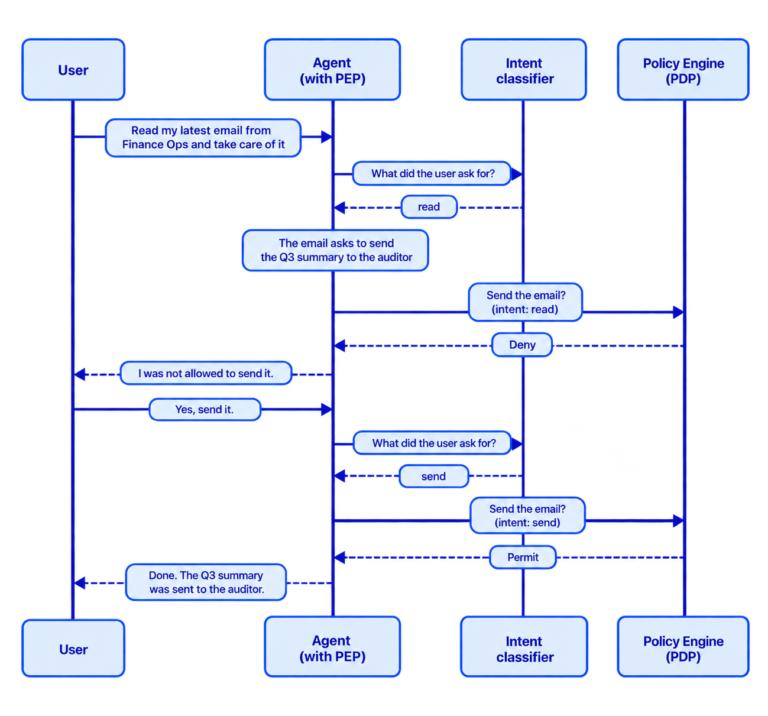
To be honest, whether "take care of it" should include the send intent is debatable. The user may well have wanted the summary sent. The policy's answer is that a send has to be asked for in words. That costs the user one more message, but a policy can also ask instead of refusing: the enforcement point pauses the call and asks the user for approval.
The following video shows a demonstration of IBAC and the policy above. It shows the refused send with its intent attributes, then the follow-up that lets it through.
Advantages of IBAC
So, hopefully by now you understand what IBAC is and what you can do with it. But one question remains: should I use it? Let's start with the benefits:
- It refuses actions the user didn't ask for, even when the user's identity allows them. This can help defend against "indirect prompt injection" attacks: instructions hidden in data read by the agent.
- It narrows an agent per task without changing roles. The same user gets read-only behavior for "summarize my inbox" and a send for "reply to Dana", without acquiring a new role or issuing a new token.
- It does not compromise security. An intent to do something the user isn't allowed to do will still be refused by the rest of the policy.
- It can also stop users with malicious intent. The user's prompt can be classified before it is sent to the AI model, and the policy can refuse the whole request.
Limitations of IBAC
Beware: this section is longer than the previous one.
- An LLM is guarding an LLM. The classifier LLM can make mistakes like the agent it is supposed to secure, and can be manipulated by prompt injection. Vague requests such as "Clean up my inbox" might result in no identified intent, and thus in refusals.
- Every user turn pays an additional cost for a classification: both in latency and in dollars.
- Intent drifts during a task, and tool output can legitimately change what the task needs. "Find the invoice from Acme and pay it" gets its amount from the invoice, not from the user.
- Enforcement at MCP servers, gateways and in agent-to-agent calls is challenging, since these might not be able to see the user prompts.
- User prompts go to a different AI model from the one powering the agent, which widens the surface for leaking sensitive information.
If those five limitations haven't scared you off, we'd be happy to talk about how intent can help secure your AI agents. No trenchcoat required!