


Identity Governance and Administration (IGA) plays a critical role in enterprise security. It helps organizations manage identities, provision access, review permissions, and demonstrate compliance. But having approved access doesn't always mean that access should be granted in every situation.
Consider an employee who has been approved to access sensitive financial records. What happens if they attempt to download those records from an unmanaged device? Or access information outside their assigned region?
IGA helps establish who should have access. Dynamic authorization determines whether that access should be allowed based on the conditions of each request.
Together, they help organizations move beyond managing permissions to enforcing the right access, under the right conditions, at the right time.
What is IGA?
IGA is a set of processes and technologies used to manage digital identities and govern access throughout their lifecycle. It helps organizations ensure that the right people have the right access to the right resources.
Many IGA implementations use role-based access control (RBAC) to simplify access management. Instead of assigning permissions to every individual, organizations group permissions into roles based on job responsibilities.
Key IGA capabilities include:
- Role and entitlement management: Organizing access based on job responsibilities and business requirements.
- Identity lifecycle management: Provisioning, updating, and removing access as employees join, move, or leave.
- Access reviews: Periodically reviewing whether users should retain their assigned permissions.
- Compliance reporting: Providing evidence of access assignments, approvals, and reviews.
These capabilities establish a strong foundation for identity security. However, governing access entitlements is not the same as evaluating every action a user attempts within an application.
Where Does IGA Stop?
IGA solutions help organizations govern access over time. They answer questions such as who has access, who approved it, and whether that access is still appropriate.
However, as organizations grow, access requirements become more complex. Roles and entitlements alone may not be enough to account for every business condition, exception, or security requirement.
This creates several challenges:
- Role explosion: When access depends on departments, locations, projects, and responsibilities, organizations may create increasingly specialized roles. Imagine an organization with 50,000 employees managing more than 54,000 roles. Maintaining and reviewing those permissions can quickly become unmanageable.
- Limited real-time context: Access decisions may need to consider device security, location, resource sensitivity, or other changing conditions.
- Broad permissions: Roles and entitlements may grant access to an application without distinguishing between individual records or actions.
- Rigid access decisions: Coarse, application-level grants can create operational challenges. Denying access entirely may prevent employees from completing legitimate tasks, while granting broad access introduces unnecessary risk.
The challenge isn't just determining whether someone has access. It's determining what they should be allowed to do under specific conditions. This is where dynamic authorization can come in to extend the capabilities of IGA.
Dynamic Authorization Can Fill The Gaps
Dynamic authorization is a modern approach to access control that evaluates requests in real time using policies and contextual information. Rather than relying solely on a user's assigned role or entitlement, dynamic authorization considers multiple attributes before determining whether an action should be permitted.
These attributes can include:
- Subject: Who is requesting access? For example, their identity, role, department, or clearance.
- Resource: What are they trying to access? For example, a customer record, financial report, or API.
- Action: What do they want to do? For example, view, edit, download, approve, or delete.
- Environment: Under what conditions is access requested? For example, location, time, device posture, or risk level.
Unlike rigid access controls, dynamic authorization can support more nuanced decisions based on the context of each request. For example, an employee accessing sensitive information from an unmanaged device might be permitted to view a record but prevented from editing or downloading it.
This allows organizations to balance security and productivity without automatically granting full access or denying access altogether. Policies can evaluate multiple conditions together, enabling more precise access decisions as business requirements change.
By evaluating these attributes against centrally managed policies, organizations can make more precise access decisions without creating a separate role for every possible scenario. Dynamic authorization can be implemented through policy-driven approaches such as attribute-based access control (ABAC), often alongside existing role-based permissions.
IGA vs. Dynamic Authorization: What’s the Difference?
IGA and dynamic authorization solve different but complementary access control challenges.
| Capability | IGA | Dynamic Authorization |
| Primary purpose | Govern identities and access entitlements | Evaluate and control access requests |
| Main question | Who should have access? | Should this action be allowed right now? |
| Access decisions | Provisioning, approvals, and periodic reviews | At runtime, when access is requested |
| Primary inputs | Identity, roles, entitlements, approvals | Identity and governed entitlements (often from IGA), plus resource, action, and context |
| Granularity | Typically accounts, roles, and entitlements | Applications, APIs, records, and individual actions |
| Enforcement | Provisions or revokes access through connected systems | Supplies policy decisions to enforcement points |
| Compliance value | Evidence of approved access and certifications | Evidence of evaluated access decisions and policy outcomes |
The distinction is not that one approach is better than the other. They operate at different points in the access lifecycle.
Combining Authorization with IGA to Lower Risk
Organizations don't need to choose between IGA and dynamic authorization. Integrating the two allows governance decisions to inform real-time access enforcement, extending existing IGA investments with more precise controls. IGA, the IdP or the directory is the attribute source, and the policy decision point (PDP) reads those attributes at runtime through policy information points (PIPs).
One important advantage is the ability to move beyond broad, all-or-nothing access rules. Instead of creating a new role for every exception or removing restrictions to avoid business disruption, organizations can define policies that permit specific actions under specific conditions.
This approach helps organizations reduce risk while maintaining productivity, without replacing their existing identity governance processes.
1. Enforce Least Privilege Beyond Assigned Roles
IGA helps ensure users receive appropriate entitlements. Dynamic authorization adds finer controls over what those entitlements allow users to do.
For example, two employees with the same role might have different access to customer records based on their assigned accounts or business relationships.
2. Respond to Changing Conditions in Real Time
Access can be evaluated using current information rather than relying entirely on permissions established during provisioning.
Policies can consider changing attributes such as location, device posture, project assignments, or resource classification.
3. Reduce Role Explosion and Administrative Overhead
Instead of creating new roles for every exception, organizations can use policy conditions to express more detailed access requirements.
This allows IGA to continue managing business roles while authorization policies handle finer-grained decisions.
4. Improve Consistency Across Applications and APIs
When authorization logic is embedded separately in individual applications, maintaining consistent access requirements becomes difficult.
Externalizing authorization policies allows organizations to manage common rules centrally and apply them across integrated systems.
The policies themselves also need governance. Like entitlements, policies are access artifacts, so changes should be versioned, reviewed, and approved before they take effect.
5. Strengthen Auditing and Compliance
IGA provides evidence of who was granted access and whether permissions were reviewed.
Dynamic authorization adds visibility into how individual access requests were evaluated, which policies applied, and whether access was permitted or denied.
Those decision logs can also flow back into IGA. Because they show which entitlements are actually used, access certifications can rely on evidence, such as a permission that hasn't been used in 90 days, instead of rubber-stamping. This is one of the most direct ways to get more value from an existing IGA investment.
6. Enforce Separation of Duties within Transactions
IGA helps prevent toxic combinations of access at the time it is granted. For example, it can stop the same person from holding both the right to create vendors and the right to approve payments to them.
Some conflicts, however, only appear within a specific transaction. Dynamic authorization enforces separation of duties (SoD) at runtime, based on the details of each request. For example, a manager may be allowed to approve purchase orders, but not an order they placed themselves. The maker and the checker are always different people, which a static, grant-time check can't guarantee.
How IGA and Dynamic Authorization Connect
In practice, IGA and dynamic authorization connect through a simple flow based on the PDP and policy enforcement point (PEP) model. This is the same model described in NIST SP 800-207, the U.S. government's Zero Trust Architecture guidance.
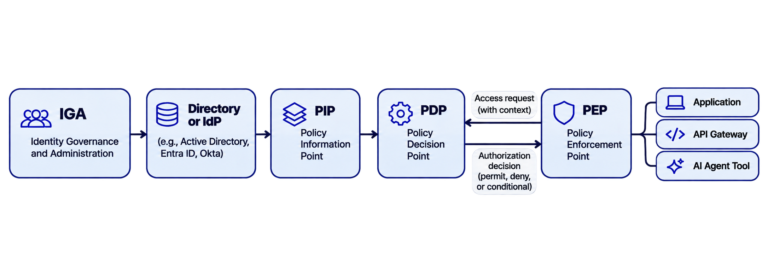
IGA governs identities, roles, and entitlements, and provisions them to the directory or identity provider (IdP). When a request arrives, policy information points (PIPs) retrieve those attributes, along with details about the resource and the environment.
The PEP, such as an application or API gateway, intercepts each request and asks the PDP whether it should be allowed. The PDP evaluates the request against centrally managed policies and returns a permit or deny decision, which the PEP enforces.
Every decision is logged, and those decision logs flow back to IGA to inform access certifications and role design. This closes the loop: IGA defines who should have access, dynamic authorization decides each request in context, and real-world usage feeds back into governance.
Extending IGA and Dynamic Authorization to AI Agents
So far, this post has focused on people. AI agents add a new kind of identity: software that uses AI models to carry out tasks on its own, such as answering questions, searching documents or updating records.
This extends what IGA needs to cover. Agents need identity lifecycle management and access certification like any employee: registration, an accountable owner, entitlements, reviews and removal. Agents that act on behalf of users also need governance of whom they may act for. Agents that run without approval, often called shadow AI, fall outside all of these processes.
But agents also stretch the point where IGA stops:
- They act quickly and often. A single task can involve dozens of data lookups and actions in other applications, all within seconds. Periodic access reviews cannot keep up with that pace.
- Their requests combine identities. When an agent acts for a user, it should never be able to do more than that user may. Neither the agent's entitlements nor the user's answer that question alone.
Dynamic authorization fills this gap by evaluating every agent action at runtime, using the same subject, resource, action and environment attributes. For agents acting on a user's instructions, the "intent" of the request becomes a useful context too.
Consider the employee from earlier, who is approved to access sensitive financial records. If they ask an AI assistant to summarize those records, the assistant should retrieve only the records that the employee may see, and should not be able to download them to an unmanaged device.
As with applications and APIs, these policies are managed centrally and enforced wherever agents act. Each agent action is also recorded with the decision and the policy that applied, providing evidence for audits and for AI regulations such as the EU AI Act.
Moving from Access Governance to Real-time Enforcement
As organizations expand across cloud services, applications, APIs, and AI-driven systems, access requirements increasingly depend on more than identity and assigned permissions.
IGA provides the governance foundation for managing identities and entitlements. Dynamic authorization extends that foundation by applying business and security policies at the moment access is requested.
By bringing the two together, organizations can preserve their existing IGA investments while gaining more precise, consistent, and context-aware access control.
Want to learn how to get more from your existing IGA investment? Download our guide, Optimizing Your IGA Investment with Authorization, to explore how policy-driven authorization can bridge the gap between access governance and runtime enforcement. Or contact one of our solution experts to talk about your specific use case.