1. Home
  2. |
  3. How ABAC Streamlines Joiner, Mover, Leaver Problems

Employees are constantly joining organizations, changing roles, and moving between departments. Each transition introduces changes to what systems, applications, and data they should be allowed to access.

Traditional role-based access control (RBAC) can make these transitions difficult to manage, particularly when employees accumulate permissions over time or retain access they no longer need. This can lead to access creep, role explosion, and increased security and compliance risks.

Policy-driven authorization helps organizations keep access aligned with the employee lifecycle. By evaluating attributes such as department, job responsibilities, employment status, and resource sensitivity, attribute-based access control (ABAC) enables dynamic access decisions that reflect current business requirements.

In this on-demand webinar, Axiomatics experts explore common joiner, mover, and leaver (JML) challenges and demonstrate how ABAC helps organizations simplify access management, reduce administrative overhead, and enforce least-privilege access as employees join, move, or leave.

Simplify Joiner, Mover, Leaver Access with Dynamic Authorization

Discover how dynamic authorization helps organizations maintain appropriate access throughout the employee lifecycle, without relying on increasingly complex role structures.

In this webinar, our experts explore:

  • Common JML access management challenges: Understand how onboarding, role changes, and employee departures can create excessive permissions, access creep, and security gaps.
  • Where traditional RBAC falls short: Explore how role explosion and static permission assignments complicate access management as employees move through an organization.
  • How ABAC supports the employee lifecycle: Learn how attribute-based policies evaluate current employee information to make more precise authorization decisions.
  • Moving from RBAC to ABAC: Discover practical approaches to introducing policy-driven authorization alongside existing identity and access management processes.

Contact us directly to schedule meeting

Scheduling a meeting in advance ensures you get dedicated time with our solution experts.

FAQs

The Joiner, Mover, Leaver (JML) lifecycle refers to the process of managing user access as employees join an organization, change roles, or leave the company. Each stage requires access to be granted, modified, or revoked promptly to ensure users have the right level of access throughout their employment.

Organizations constantly hire new employees, reorganize teams, and introduce new applications. When access changes rely on manual updates or static roles, permissions can quickly become outdated, leading to delays, inconsistent access, and increased administrative overhead.

Attribute-based access control (ABAC) makes authorization decisions based on attributes such as department, job function, location, employment status, or project assignment. As these attributes change, access is updated automatically through policy evaluation, reducing the need for manual permission changes and helping ensure users always have appropriate access.

Yes. Because access decisions are driven by centralized policies and current business attributes rather than large numbers of static roles, organizations can more easily understand why access was granted, demonstrate least-privilege principles, and simplify periodic access reviews and audits.

Access creep occurs when users accumulate permissions over time that are no longer required for their current role. This often happens when employees change positions but retain access from previous responsibilities, increasing security risks and making compliance more difficult.

Playbook

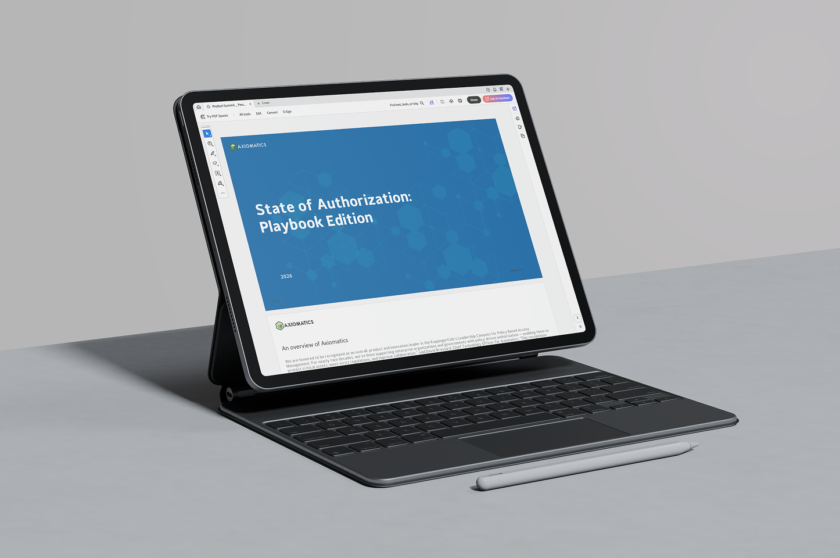
Download our State of Authorization: Playbook Edition

Leveraging our more than twenty years of experience, The State of Authorization: Playbook Edition shares the journey enterprises take from learning what authorization is all the way through to deployment of an authorization solution.

See What Events the Axiomatics Team Is Attending Across the Globe

This website uses cookies

Cookies consist of small text files. They contain data that is stored on your device. To enable us to place certain types of cookies we need to obtain your consent. At Axiomatics AB, corp. ID no. 556708-1012, we use the following kinds of cookies. To read more about which cookies we use and storage times, click here to access our cookies policy.

Manage your cookie-settings

Necessary cookies

Check to consent to the use of Necessary cookies

Nödvändiga cookies

Cookie Syfte Lagringstid
consents

Används för att hantera samtycke

1 år
__hssrc

Närhelst HubSpot ändrar sessionscookien, ställs denna cookie också in för att avgöra om besökaren har startat om sin webbläsare.

Session

Cookies for statistics

Check to consent to the use of Cookies for statistics

Cookies för statistik

Cookie Syfte Lagringstid
__hssc

För att lagra anonymiserad statistik.

30 minuter
_gcl_au

För att lagra och spåra konverteringar.

3 månader


Cookies for ad-tracking

Check to consent to the use of Cookies for ad-tracking

Cookies för annonsmätning

Cookie Syfte Lagringstid
__hstc

För att lagra besökstid.

6 månader
hubspotutk

För att lagra och spåra en besökares identitet.

6 månader


Ad measurement user cookies

Check to consent to the use of Ad measurement user cookies
In order to show relevant ads we place cookies to tailor ads for you

Personalized ads cookies

Check to consent to the use of Personalized ads cookies
To show relevant and personal ads we place cookies to provide unique offers that are tailored to your user data