1. Home
  2. |
  3. The ABAC Recap: What You Should Know About Authorization

Authorization determines what users, applications, and services are allowed to access or do within a system. As organizations adopt more cloud applications, APIs, and distributed services, traditional access control approaches may struggle to accommodate increasingly complex requirements.

Attribute-based access control (ABAC) provides a more flexible approach by evaluating attributes associated with users, resources, actions, and environmental conditions to determine whether access should be granted.

In this on-demand webinar, Axiomatics experts break down the fundamentals of authorization, explore common access control challenges, and explain how dynamic, policy-driven authorization helps organizations enforce fine-grained access control across their environments.

What You'll Learn about ABAC and Modern Authorization

Whether you're new to authorization or looking to refresh your knowledge, this webinar explores the fundamentals of modern access control and how organizations can move beyond static permissions.

In this session, our experts discuss:

  • Authentication vs. authorization: Understand the difference between verifying identity and determining what users or applications are allowed to do.
  • Common access control challenges: Explore why role explosion, hard-coded permissions, and fragmented authorization policies make access management more complex.
  • Understanding ABAC: Learn how attributes and contextual conditions support more precise, fine-grained access decisions.
  • Dynamic authorization in practice: Discover how policy-driven authorization helps organizations enforce consistent access policies across applications, APIs, and sensitive data.

Contact us directly to schedule meeting

Scheduling a meeting in advance ensures you get dedicated time with our solution experts.

FAQs

Role-based access control (RBAC) grants access based on predefined roles, while attribute-based access control (ABAC) evaluates attributes about users, resources, actions, and environmental conditions. ABAC provides greater flexibility and helps eliminate the need for excessive role creation.

Authorization is the process of determining what an authenticated user, application, or service is allowed to access and what actions they can perform. While authentication answers, "Who are you?", authorization answers, "What are you allowed to do?"

Modern, policy-driven authorization evaluates access requests in real time using identity, resource, action, and contextual information to enforce fine-grained access control.

Authentication verifies a user's identity, typically through credentials such as passwords, passkeys, or multi-factor authentication (MFA). Authorization takes place after authentication and determines which applications, data, APIs, or resources that authenticated user can access based on organizational policies and business rules.

Yes. Many organizations use a hybrid approach that combines RBAC and ABAC. Roles provide a baseline set of permissions, while ABAC policies evaluate contextual attributes to refine access decisions. This allows organizations to preserve existing RBAC investments while adding fine-grained authorization where needed.

Playbook

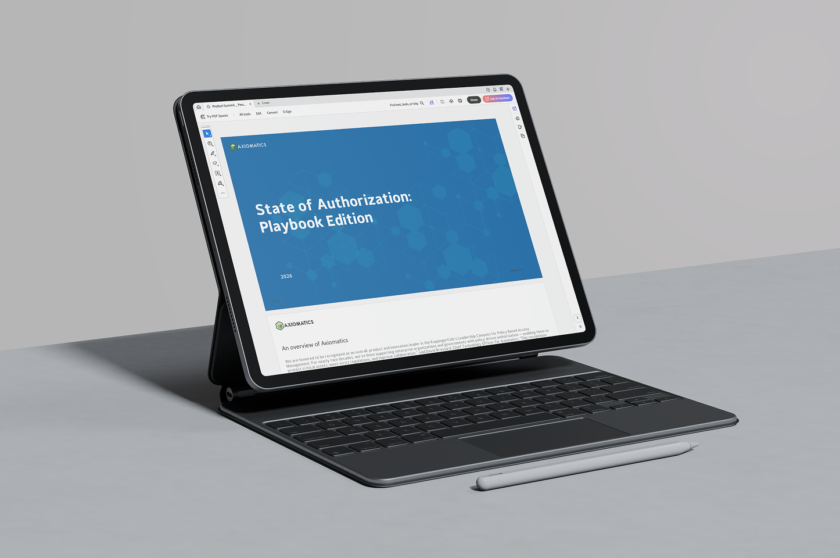
Download our State of Authorization: Playbook Edition

Leveraging our more than twenty years of experience, The State of Authorization: Playbook Edition shares the journey enterprises take from learning what authorization is all the way through to deployment of an authorization solution.

See What Events the Axiomatics Team Is Attending Across the Globe

This website uses cookies

Cookies consist of small text files. They contain data that is stored on your device. To enable us to place certain types of cookies we need to obtain your consent. At Axiomatics AB, corp. ID no. 556708-1012, we use the following kinds of cookies. To read more about which cookies we use and storage times, click here to access our cookies policy.

Manage your cookie-settings

Necessary cookies

Check to consent to the use of Necessary cookies

Nödvändiga cookies

Cookie Syfte Lagringstid
consents

Används för att hantera samtycke

1 år
__hssrc

Närhelst HubSpot ändrar sessionscookien, ställs denna cookie också in för att avgöra om besökaren har startat om sin webbläsare.

Session

Cookies for statistics

Check to consent to the use of Cookies for statistics

Cookies för statistik

Cookie Syfte Lagringstid
__hssc

För att lagra anonymiserad statistik.

30 minuter
_gcl_au

För att lagra och spåra konverteringar.

3 månader


Cookies for ad-tracking

Check to consent to the use of Cookies for ad-tracking

Cookies för annonsmätning

Cookie Syfte Lagringstid
__hstc

För att lagra besökstid.

6 månader
hubspotutk

För att lagra och spåra en besökares identitet.

6 månader


Ad measurement user cookies

Check to consent to the use of Ad measurement user cookies
In order to show relevant ads we place cookies to tailor ads for you

Personalized ads cookies

Check to consent to the use of Personalized ads cookies
To show relevant and personal ads we place cookies to provide unique offers that are tailored to your user data