1. Home
  2. |
  3. Bringing Control to Agents: How Axiomatics and The Automagicians Secure AI

AI agents are transforming how organizations interact with enterprise data, but they also introduce new security challenges. As agents retrieve information, interact with databases, and perform tasks on behalf of users, how can organizations ensure they only access the information they're authorized to see?

Authentication alone isn't enough. Organizations need fine-grained, policy-driven authorization to control what AI agents can access based on user permissions, resource sensitivity, and context.

In this webinar, Axiomatics and The Automagicians explore how the Imago Platform integrates with Axiomatics Authorization Management Platform (AMP) to enforce access policies before sensitive data reaches AI agents and large language models (LLMs).

Through a practical demonstration, discover how centralized authorization policies help organizations secure AI workflows without compromising the user experience.

See Fine-grained Authorization for AI Agents in Action

Discover how Axiomatics and The Automagicians bring policy-driven authorization into AI workflows, helping organizations control access to sensitive enterprise data.

In this session, our experts explore:

  • The security challenges of AI agents: Understand why agents that retrieve and process enterprise data need more than traditional access controls.
  • Integrating authorization into AI workflows: Explore how the Imago Platform and Axiomatics work together to evaluate access requests before data reaches AI agents.
  • Fine-grained data access control: See how authorization policies determine which records and sensitive fields users can access.
  • A real-world demonstration: Discover how different users can receive appropriately filtered results from the same AI prompt based on their access permissions.

Securing AI and LLMs: The Road to Governance

Want to explore the architecture in more detail? Read our technical breakdown of how Axiomatics secures AI agents with fine-grained, policy-driven authorization.

FAQs

Enterprise AI agents often interact with multiple applications, databases, and sensitive information. Policy-driven authorization allows organizations to manage access rules centrally and enforce them consistently, helping ensure AI agents operate within defined security and business requirements.

Yes. With fine-grained authorization, AI applications can return different information based on each user's access permissions. For example, an executive may be permitted to view confidential financial information, while another employee receives results with sensitive fields restricted.

Organizations can prevent unauthorized AI agent access by enforcing fine-grained authorization policies before sensitive data is retrieved or processed. Policy-driven authorization evaluates user permissions, resource attributes, and contextual conditions to determine what information an AI agent is allowed to access.

AI agents frequently perform tasks across multiple enterprise systems on behalf of users. Fine-grained authorization allows organizations to evaluate each request based on attributes such as the user, resource, action, data sensitivity, and business context. This provides far greater flexibility and security than relying solely on static roles or broad permissions.

Yes. AI agents often access multiple applications, APIs, and data sources on behalf of users. A centralized policy engine can evaluate each request dynamically, ensuring AI systems only perform actions and access data that comply with organizational policies and least-privilege principles. This makes the policy engine a key component for extending Zero Trust to modern AI architectures.

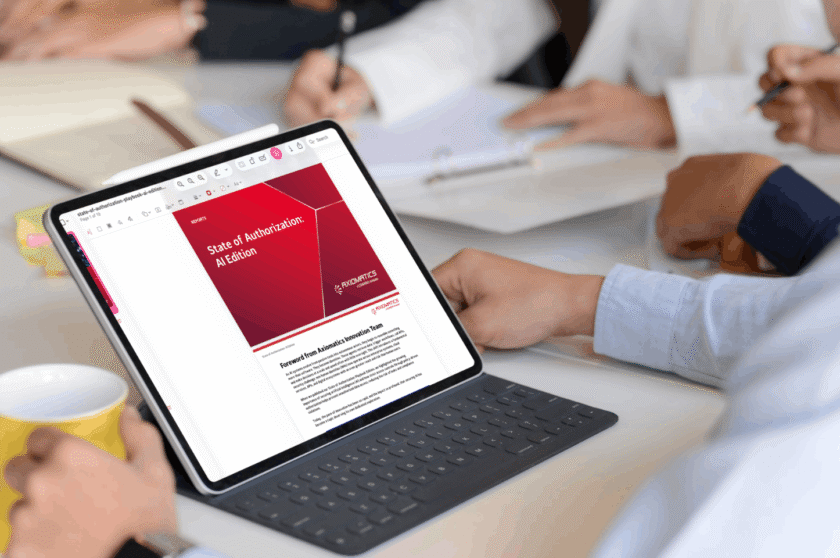
State of Authorization: AI Edition open on someone's tablet

Playbook

Download our State of Authorization: AI Edition

Leveraging our more than twenty years of experience, The State of Authorization: AI Edition explores the unique risks introduced by AI systems,
the architectural patterns required to control them, and practical guidance for implementing policy-driven authorization in AI-enabled environments.

See What Events the Axiomatics Team Is Attending Across the Globe

This website uses cookies

Cookies consist of small text files. They contain data that is stored on your device. To enable us to place certain types of cookies we need to obtain your consent. At Axiomatics AB, corp. ID no. 556708-1012, we use the following kinds of cookies. To read more about which cookies we use and storage times, click here to access our cookies policy.

Manage your cookie-settings

Necessary cookies

Check to consent to the use of Necessary cookies

Nödvändiga cookies

Cookie Syfte Lagringstid
consents

Används för att hantera samtycke

1 år
__hssrc

Närhelst HubSpot ändrar sessionscookien, ställs denna cookie också in för att avgöra om besökaren har startat om sin webbläsare.

Session

Cookies for statistics

Check to consent to the use of Cookies for statistics

Cookies för statistik

Cookie Syfte Lagringstid
__hssc

För att lagra anonymiserad statistik.

30 minuter
_gcl_au

För att lagra och spåra konverteringar.

3 månader


Cookies for ad-tracking

Check to consent to the use of Cookies for ad-tracking

Cookies för annonsmätning

Cookie Syfte Lagringstid
__hstc

För att lagra besökstid.

6 månader
hubspotutk

För att lagra och spåra en besökares identitet.

6 månader


Ad measurement user cookies

Check to consent to the use of Ad measurement user cookies
In order to show relevant ads we place cookies to tailor ads for you

Personalized ads cookies

Check to consent to the use of Personalized ads cookies
To show relevant and personal ads we place cookies to provide unique offers that are tailored to your user data