1. Home
  2. |
  3. Ask an Axiomatics Expert: Top 10 Authorization FAQs Answered

Modern authorization raises important questions for organizations looking to strengthen security, simplify access management, and meet evolving compliance requirements.

Is role-based access control (RBAC) enough? How should organizations manage authorization policies? And how can fine-grained authorization integrate with existing applications, APIs, and identity systems?

In this on-demand webinar, Axiomatics experts answer 10 common authorization questions from customers and security teams. From choosing the right access control model to managing policies and scaling authorization across enterprise environments, the session provides practical guidance for building a more flexible, policy-driven authorization strategy.

Get Answers to the Most Common Authorization Questions

From access control models to implementation best practices, our experts address common questions organizations face when modernizing authorization.

In this session, we explore:

  • Choosing the right access control model: Understand where RBAC works well and when fine-grained approaches such as ABAC can address more complex requirements.
  • Managing authorization policies: Learn best practices for creating, testing, updating, and maintaining policies as business requirements evolve.
  • Integrating authorization with existing systems: Explore how policy-driven authorization works alongside applications, APIs, identity providers, and existing IAM infrastructure.
  • Supporting security, compliance, and scalability: Discover how centralized authorization policies can help organizations enforce consistent access decisions and support audit requirements.

Contact us directly to schedule meeting

Scheduling a meeting in advance ensures you get dedicated time with our solution experts.

FAQs

Role-based access control (RBAC) grants access based on predefined roles, while attribute-based access control (ABAC) evaluates attributes about users, resources, actions, and environmental conditions. ABAC provides greater flexibility and helps eliminate the need for excessive role creation.

No. Policy-driven authorization uses roles as one of many attributes in an access decision, alongside factors such as user characteristics, resource sensitivity, location, and risk. By evaluating these conditions at runtime, organizations can simplify and reduce the number of roles needed while achieving more precise, context-aware access control.

Policy-driven authorization evaluates access requests in real time using attributes and contextual information. This limits unnecessary access, reduces standing privileges, and helps contain compromised accounts.

Access control is the foundation of a Zero Trust strategy. While authentication verifies who a user or identity is, access control determines what they can do once inside.

In a Zero Trust model, access control is dynamic and policy-driven, evaluating contextual factors before granting or maintaining access. This ensures that every request is verified in real time, limiting permissions to the minimum necessary and preventing lateral movement across systems. Without fine-grained, context-aware access control, the “never trust, always verify” principle of Zero Trust cannot be fully achieved.

No. Policy-driven authorization complements existing IGA and access management solutions. Identity providers and access management authenticate users, IGA governs identity lifecycles and access reviews, and policy-driven authorization makes runtime access decisions based on centralized policies and current context.

Playbook

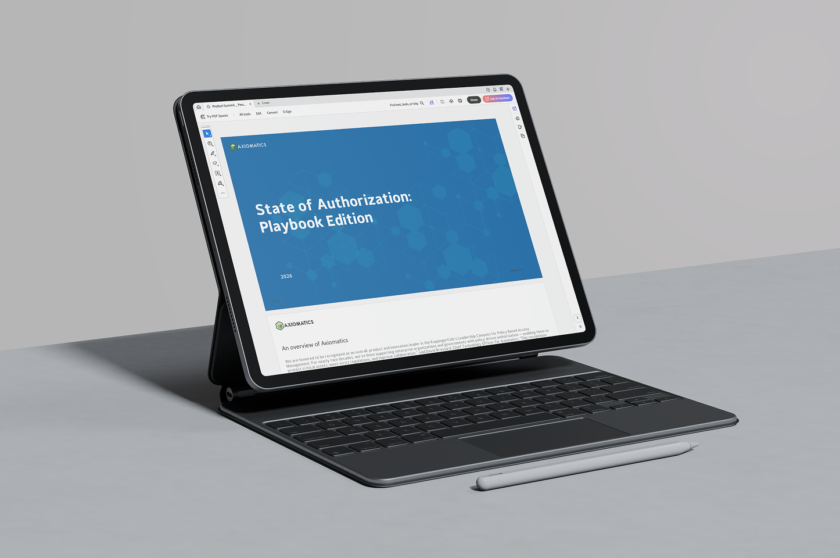
Download our State of Authorization: Playbook Edition

Leveraging our more than twenty years of experience, The State of Authorization: Playbook Edition shares the journey enterprises take from learning what authorization is all the way through to deployment of an authorization solution.

See What Events the Axiomatics Team Is Attending Across the Globe

This website uses cookies

Cookies consist of small text files. They contain data that is stored on your device. To enable us to place certain types of cookies we need to obtain your consent. At Axiomatics AB, corp. ID no. 556708-1012, we use the following kinds of cookies. To read more about which cookies we use and storage times, click here to access our cookies policy.

Manage your cookie-settings

Necessary cookies

Check to consent to the use of Necessary cookies

Nödvändiga cookies

Cookie Syfte Lagringstid
consents

Används för att hantera samtycke

1 år
__hssrc

Närhelst HubSpot ändrar sessionscookien, ställs denna cookie också in för att avgöra om besökaren har startat om sin webbläsare.

Session

Cookies for statistics

Check to consent to the use of Cookies for statistics

Cookies för statistik

Cookie Syfte Lagringstid
__hssc

För att lagra anonymiserad statistik.

30 minuter
_gcl_au

För att lagra och spåra konverteringar.

3 månader


Cookies for ad-tracking

Check to consent to the use of Cookies for ad-tracking

Cookies för annonsmätning

Cookie Syfte Lagringstid
__hstc

För att lagra besökstid.

6 månader
hubspotutk

För att lagra och spåra en besökares identitet.

6 månader


Ad measurement user cookies

Check to consent to the use of Ad measurement user cookies
In order to show relevant ads we place cookies to tailor ads for you

Personalized ads cookies

Check to consent to the use of Personalized ads cookies
To show relevant and personal ads we place cookies to provide unique offers that are tailored to your user data